Books Trending News – Guaripete | Online Store |
- Romance on The 1A, Today at 11am ET!
- A Duke by Default by Alyssa Cole
- Links: Speeches, Podcasts, & Magic
- Edward Snowden Reconsidered
- Imploding with Cool
- In Tribute to Joyce Carol Oates
- To Be At Home Everywhere
- What David Foster Wallace Ate
| Romance on The 1A, Today at 11am ET! Posted: 13 Sep 2018 07:05 AM PDT 
"Just Can't Help Falling in Love…With Romance Novels" will begin at 11, and will feature Alisha Rai, Leah Koch from The Ripped Bodice, Alexandra Alter from the Times, Alyssa Cole, and me. It's live radio, too, so you'll get to hear me when I'm extra nervous and trying to keep my cool. You can tune in on The1A.org, and the show is also broadcast on a number of NPR stations across the US. Now I will begin taking deep breaths and hoping I don't sneeze into the mic or something equally embarrassing. The post Romance on The 1A, Today at 11am ET! appeared first on GuaripeteMagazine. |
| A Duke by Default by Alyssa Cole Posted: 13 Sep 2018 07:05 AM PDT  Genre: Romance, Contemporary Romance Theme: Fairy Tale, Workplace, Class Differences, Enemies to Lovers, Crush, Friends with Benefits/No Strings Attached, Opposites Attract, Age Difference, Fish Out of Water Archetype: Royalty, Diverse Protagonists, Highlander/Scot, Blue Collar I loved A Duke by Default so freaking much. This is the second book in Alyssa Cole's Reluctant Royals series and it focuses on Portia, the best friend of the heroine of the first book, A Princess in Theory. A Duke by Default is fine as a stand alone although characters from the first book do show up. In the first book, Portia was introduced as a party girl who couldn't stick to anything and who frequently imposed on her friends despite having a heart of gold. In A Duke by Default, Portia is working on "Project: New Portia." She has very sensibly launched this project by quitting drinking, finding a therapist, and taking a break from casual sex (not that there's anything wrong with casual sex, but in Portia's case it was part of an overall pattern of heavy drinking and lack of commitment that had become problematic for her). Don't worry if you didn't meet Portia in the first book. All of her issues are explained or implied in A Duke by Default. Anyway, Portia takes on an apprenticeship in Scotland with a swordsmith. She's supposed to learn how to make and use swords in exchange for helping the armory business with its social media game, which is nonexistent. The swordsmith is a very sexy guy named Tavish who immediately dismisses her as superfluous. His brother set up the apprenticeship. Tavish is not a social media kind of guy. Portia quickly meets a sublime group of supporting characters, impresses the hell out of Tavish, and accidentally discovers that Tavish is the son of a duke (it's very complicated). In short order the reader learns about ADHD, immigration in Scotland, and how to stir your tea at an aristocratic event (move the spoon in straight lines to stir your tea as opposed to in a circular motion). Portia learns about boundaries and that she's not a "fuck-up." Therapy is portrayed in a positive light, which is awesome, and while the press tries to slut shame Portia for her previous casual sex encounters, the other characters refuse to do so. There's very much an attitude of "Whatever works for you and your partner(s) is fine." Meanwhile, Tavish learns, as he puts it, not to be such a "wanker." By "wanker" I mean that he tends to take the people around him for granted even though he is extremely empathetic towards the larger community. He's fiercely loyal and protective of people in his life, but he doesn't always appreciate the hard work they do on his behalf. He also has to make a decision about whether or not to take his place as Duke and how to deal with the press given that he is intensely private. The book has plenty of plot but the plot is pretty much there so that the characters can react in different ways. Also, the novel ends abruptly as soon as the protagonists resolve their feelings towards one another. The novel is a little overstuffed with people's issues but all the issues are important and all are handled well. I liked the settings – a gentrifying urban area that's pushing out long term residents, the armory with its forge, shop, and school, the Ren Faire, and Holyrood Palace as a change of scene. It's a great combination of gritty, historical, and glamorous. I also liked that the characters demonstrated that urban Scotland is an economically and ethnically diverse place. Tav's mother is Chilean and his adoptive father is Jamaican, Portia is African-American, and many of Tav's students are refugees from Syria. Portia becomes fast friends with Cheryl, Tav's sister-in-law, who runs a food stand called "Doctor Hu's." It's a lovely depiction of a tight-knit family in a tight-knit community. I liked Tavish very much, but I found I cared more about Portia, who has a complex and well-done character arc. Again, I LOVED it that therapy is presented in a positive light! I was more invested in Portia's personal growth than in the romance, which is saying a lot, because I was really into the romance. This is such a solid book – it's tear-jerking, it's inspiring, it's sexy and romantic, it's interesting (sword history!) and it's funny. I can't wait for the next book in the series. The post A Duke by Default by Alyssa Cole appeared first on GuaripeteMagazine. |
| Links: Speeches, Podcasts, & Magic Posted: 13 Sep 2018 07:04 AM PDT 
… Sarah: Tomorrow, 13 September at around 11am ET, NPR/WAMU's 1A is doing a segment on romance, with Alisha Rai, Alexandra Alter from the Times, Leah Koch from The Ripped Bodice, and me! You can tune in or listen live at the 1A website: https://the1a.org/ … Love bookish podcasts? BuzzFeed has a list of thirty-one of them and we've made the cut! Thanks to all the readers who let us know about it. … If you missed the Romance Writers of Australia conference, Kate Cuthbert's keynote address is available to read online: If we want to call ourselves a feminist genre, if we want to hold ourselves up as an example of women being centered, of representing the female gaze, of creating women heroes who not only survive but thrive, then we have to lead. We can't deflect and we can't dissemble. We need to look to the future and create the books that women need to read now. We've been shown our potential. To rise to it is our obligation. And this is where it gets tricky, because as a community, we have to do the one thing that romance has never taught us how to do: breakup. What do you think of the speech? … Check out the Royal Service Dogs: Advocacy and Art Facebook page. The artist, Arien Smith, wanted to increase awareness of individuals with both visible and invisible disabilities by portraying Disney characters with service dogs. … Orbit has a really fun graph on the different kinds of mages and where to find them. I'm definitely feeling the Witch Queen.
… Don't forget to share what super cool things you've seen, read, or listened to this week! And if you have anything you think we'd like to post on a future Wednesday Links, send it my way! The post Links: Speeches, Podcasts, & Magic appeared first on GuaripeteMagazine. |
| Posted: 13 Sep 2018 07:04 AM PDT   Former NSA contractor Edward Snowden delivering a speech by video-link from Russia to a conference in Lisbon, Portugal, May 30, 2017 This summer, the fifth anniversary of Edward Snowden's revelations about NSA surveillance passed quietly, adrift on a tide of news that now daily sweeps the ground from under our feet. It has been a long five years, and not a period marked by increased understanding, transparency, or control of our personal data. In these years, we've learned much more about how Big Tech was not only sharing data with the NSA but collecting vast troves of information about us for its own purposes. And we've started to see the strategic ends to which Big Data can be put. In that sense, we're only beginning to comprehend the full significance of Snowden's disclosures. This is not to say that we know more today about Snowden's motivations or aims than we did in 2013. The question of whether or not Snowden was a Russian asset all along has been raised and debated. No evidence has been found that he was, just as no evidence has been found that he was a spy for China. His stated cause was the troubling expansion of surveillance of US citizens, but most of the documents he stole bore no relation to this avowed concern. A small percentage of what Snowden released of the 1.7 million documents that intelligence officials believe he accessed did indeed yield important information about domestic programs—for example, the continuation of Stellar Wind, a vast warrantless surveillance program authorized by George W. Bush after 9/11, creating legal structures for bulk collection that Obama then expanded. But many of them concerned foreign surveillance and cyberwarfare. This has led to speculation that he was working on behalf of some other organization or cause. We can't know. Regardless of his personal intentions, though, the Snowden phenomenon was far larger than the man himself, larger even than the documents he leaked. In retrospect, it showed us the first glimmerings of an emerging ideological realignment—a convergence, not for the first time, of the far left and the far right, and of libertarianism with authoritarianism. It was also a powerful intervention in information wars we didn't yet know we were engaged in, but which we now need to understand. In 2013, the good guys and bad guys appeared to sort themselves into neat and recognizable groups. The "war on terror" still dominated national security strategy and debate. It had made suspects of thousands of ordinary civilians, who needed to be monitored by intelligence agencies whose focus throughout the cold war had been primarily on state actors (the Soviet Union and its allies) that were presumed to have rational, if instrumental intentions. The new enemy was unreason, extremism, fanaticism, and it was potentially everywhere. But the Internet gave the intelligence community the capacity, if not the legal right, to peer behind the curtains of almost any living room in the United States and far beyond. Snowden, by his own account, came to warn us that we were all being watched, guilty and innocent alike, with no legal justification. To those concerned primarily with security, the terrorists were the hidden hostile force. To many of those concerned about liberty, the "deep state" monitoring us was the omnipresent enemy. Most people managed to be largely unconcerned about both. But to the defenders of liberty, whether left liberals or libertarians, Snowden was straightforwardly a hero. Alan Rusbridger, the editor of The Guardian at the time, said of him:
The patriotic right, the internationalist left: these were the recognized camps in the now far-distant world of 2013. Snowden, who kept a copy of the US Constitution on his desk at the NSA, could be regarded by his sympathizers as a patriot engaging in a lone act of bravery for the benefit of all. Of course, it wasn't a solitary act. Snowden didn't want to be purely a whistleblower like Mark Felt or Daniel Ellsberg; he wanted to be a figurehead. And he largely succeeded. For the last five years, the quietly principled persona he established in the public mind has galvanized opposition to the American "deep state," and it has done so, in part, because it was promoted by an Academy Award-winning documentary film in which Snowden starred, a feature film about him directed by Oliver Stone in which he made an appearance, and the many talks he gives by video-link that have become his main source of income. He now has 3.83 million Twitter followers. He is an "influencer," and a powerful one. Any assessment of the impact of his actions has to take into account not just the content of the documents he leaked, but the entire Edward Snowden Show. In fact, most of what the public knows about Snowden has been filtered through the representations of him put together by a small, tight circle of chosen allies. All of them were, at the time, supporters of WikiLeaks, with whom Snowden has a troubled but intimate relationship. He initially considered leaking documents through WikiLeaks but changed his mind, he claims, in 2012 when Assange was forced into asylum at the Ecuadorian embassy in London under heavy surveillance, making access to him seem too difficult and risky. Instead, Snowden tried to make contact with one of WikiLeaks' most vocal defenders, the independent journalist Glenn Greenwald. When he failed, he contacted the documentary filmmaker Laura Poitras, whom Greenwald had also vociferously defended when she drew unwanted government scrutiny after making a documentary film that followed a man who had been Osama bin Laden's bodyguard. The scrutiny turned into harassment in 2011, she claims, when she began making a film about WikiLeaks. Poitras had been a member of the Tor Project community (which developed the encrypted Tor web browser to make private online interactions possible) since 2010 when she reached out to Jacob Appelbaum, an important member of both the Tor Project and also WikiLeaks, after becoming a close friend and ally of Assange. We know from Wired's Kevin Poulsen that Snowden was already in touch with the Tor community at least as early as 2012, having contacted Tor's Runa Sandvik while he was still exfiltrating documents. In December 2012, he and Sandvik hosted a "crypto party" in Honolulu, where Snowden ran a session teaching people how to set up Tor servers. And it was through Tor's Micah Lee (now working for The Intercept) that Snowden first contacted Poitras. In order to vet Snowden, Poitras turned to Appelbaum. Given the overlap between the Tor and WikiLeaks communities, Snowden was involved with the latter at least as early as his time working as a contractor for the NSA, in a job he took specifically in order to steal documents, in Hawaii.  Director Laura Poitras and journalist Glenn Greenwald accepting an Academy Award for the documentary Citizenfour, Hollywood, California, February 22, 2015 Few people knew, when Citizenfour was released in 2014, how deeply embedded in both Tor and WikiLeaks Poitras was or how close an ideological affinity she then had with Assange. The Guardian had sensibly sent the experienced news reporter Ewen MacAskill with Poitras and Greenwald to Hong Kong, and this helped to create the impression that the interests of Snowden's confidants were journalistic rather than ideological. We have subsequently seen glimpses of Poitras's complex relationship with Assange in Risk, the version of her WikiLeaks film that was released in 2017. But Risk is not the movie she thought she was making at the time. The original film, called Asylum, was premiered at Cannes in 2016. Steven Zeitchik, of the Los Angeles Times, described it as a "lionizing portrait," presenting Assange as a "maverick hero." In Risk, on the other hand, we are exposed more to Assange's narcissism and extremely unpleasant attitudes toward women, along with a wistful voiceover from Poitras reading passages from her production diary, worrying that Assange doesn't like her, recounting a growing ambivalence about him. In between the two films, Assange lost many supporters because of the part he played in the 2016 US elections, when WikiLeaks published stolen emails—now believed to have been hacked and supplied by Russian agents—that were damaging to Hillary Clinton. But Zeitchik discovered, when he asked Poitras about her own change of heart, that it wasn't political but personal. Assange had turned his imperious attitude toward women on her, demanding before the Cannes screening that she cut material relating to accusations of rape by two women in Sweden. His tone, in particular, offended her. But her view of his actions leading up to the US election remained consistent with that of WikiLeaks supporters; he published the DNC emails because they were newsworthy, not as a tactic in an information war. When Snowden initially contacted Poitras, she tells us in Risk, her first thought was that the FBI was trying to entrap her, Appelbaum, or Assange. Though Micah Lee and Appelbaum were both aware of her source, she tells us that she left for Hong Kong without Assange's knowledge and that he was furious that she failed to ensure WikiLeaks received Snowden's documents. Although Poitras presents herself retrospectively as an independent actor, while filming Snowden in Hong Kong she contacted Assange about arranging Snowden's asylum and left him in WikiLeaks' hands (through Assange's emissary, Sarah Harrison). Poitras's relations with Assange later became strained, but she remained part of the Tor Project and was involved in a relationship with Jacob Appelbaum. (She shows in the film that Appelbaum was subsequently accused of multiple counts of sexual harassment over a number of years.) In Risk's added, post-production voiceover, Poitras says of the Snowden case: "When they investigate this leak, they will create a narrative to say it was all a conspiracy. They won't understand what really happened. That we all kept each other in the dark." It's not clear exactly what she means. But it is clear that "we all" means a community of like-minded and interdependent people; people who may each have their own grandiose ambitions and who have tortuously complex, manipulative, and secretive personal relationships with one another. Snowden chose to put himself in their hands. If this group of people shared a political ideology, it was hard to define. They were often taken to belong to the left, since this is where criticisms of the national security state have tended to originate. But when Harrison, the WikiLeaks editor and Assange adviser, flew to Hong Kong to meet Snowden, she was coming directly from overseeing Assange's unsuccessful electoral campaign for the Australian Senate, in which the WikiLeaks Party was apparently aligned with a far-right party. The WikiLeaks Party campaign team, led by Assange's father and party secretary John Shipton, had made a high-profile visit to Syria's authoritarian leader, Bashar al-Assad, and Shipton had heaped praise on Vladimir Putin's efforts in the region, in contrast to America's, in an interview with the state radio network Voice of Russia. The political historian Sean Wilentz, in what at the time, in 2014, was a rare critical article on Assange, Snowden, and Greenwald, argued that they shared nothing so coherent as a set of ideas but a common political impulse, one he described as "paranoid libertarianism." With hindsight, we can also see that when they first became aligned, the overwhelming preoccupation of Poitras, Greenwald, Assange, and Snowden was the hypocrisy of the US state, which claimed to abide by international law, to respect human rights, to operate within the rule of law internally and yet continually breached its own purported standards and values. They had good grounds for this view. The Iraq War, which was justified to the public using lies, fabricated evidence, and deliberate obfuscation of the overall objective, resulted in hundreds of thousands of deaths, as well as the rendition and torture of suspected "enemy combatants" at CIA black sites and their indefinite detention at Guantánamo Bay. The doctrine of preemptive war had been revived, along with imperialist ambitions for a global pax Americana. But cynicism about the rule of law exists on a spectrum. At one end, exposing government hypocrisy is motivated by a demand that a liberal-democratic state live up to its own ideals, that accountability be reinforced by increasing public awareness, establishing oversight committees, electing proactive politicians, and employing all the other mechanisms that have evolved in liberal democracies to prevent arbitrary or unchecked rule. These include popular protests, the civil disobedience that won civil rights battles, and, indeed, whistleblowing. At the other end of the spectrum is the idea that the law is always really politics in a different guise; it can provide a broad set of abstract norms but fails to specify how these should be applied in particular cases. Human beings make those decisions. And the decision-makers will ultimately be those with the most power. On this view, the liberal notions of legality and legitimacy are always hypocritical. This was the view promulgated by one of the most influential legal theorists of the twentieth century, Carl Schmitt. He was a Nazi, who joined the party in 1933 and became known as the "crown jurist" of the Third Reich. But at the turn of the millennium, as Bush took America to war, Schmitt's criticisms of liberalism were undergoing a renaissance on both the far right and the far left, especially in the academy. This set of attitudes has not been limited to high theory or confined to universities, but its congruence with authoritarianism has often been overlooked. In Risk, we hear Assange say on the phone, regarding the legality of WikiLeaks' actions in the US: "We say we're protected by the First Amendment. But it's all a matter of politics. Laws are interpreted by judges." He has repeatedly expressed the view that the idea of legality is just a political tool (he especially stresses this when the one being accused of illegality is him). But the cynicism of the figures around Snowden derives not from a meta-view about the nature of law, like Schmitt's, but from the view that America, the most powerful exponent of the rule of law, merely uses this ideal as a mask to disguise the unchecked power of the "deep state." Snowden, a dissenting agent of the national security state brandishing his pocket Constitution, was seen by Rusbridger as an American patriot, but by his chosen allies as the most authoritative revealer of the irremediable depth of American hypocrisy. In the WikiLeaks universe, the liberal ideal of the rule of law, both domestic and international, has been the lie that allows unaccountable power to grow into a world-dominating force. Sarah Harrison insists that the US, with the help of its allies, has constructed "a huge global intelligence, diplomatic, and military net that tries to see all, know all, govern all, decide all. It reaches all, and yet it is acting without [sic] impunity. This is the greatest unaccountable power of today—the United States and our Western democracies." Greenwald has gradually shifted toward a similar position. Having initially supported the wars in Afghanistan and Iraq but then been appalled by the civilian casualties and the use of torture, he asked in 2017: "Who has brought more death, and suffering, and tyranny to the world over the last six decades than the US national security state?" This view of the US as the most malign actor in the world has now made him reluctant to criticize the actions of foreign states like Putin's Russia. For example, asked about the Novichok poisoning of a former Russian spy in Salisbury, England, an attempted assassination attributed to the Kremlin, he responds that Obama's drone strikes were morally no different—a gambit that, perhaps inadvertently, mimics the "whataboutism" of the Kremlin itself. But it wouldn't make sense for Greenwald to refuse to condemn the misdeeds of other states on the grounds that America's are worse unless he had come to feel that all such judgments are a moralistic charade, that power politics is the only game in town. In this light, it is extremely significant that Snowden's famous leak of documents revealing the NSA's PRISM surveillance program was misinterpreted when it was first disclosed by Greenwald and Barton Gellman of The Washington Post in a way that implied total lawlessness at the NSA. (According to Greenwald's book on the Snowden leaks, Gellman was put under significant pressure by Snowden to publish before the Post had made the rigorous checks it wanted.) The initial story, as run by both Gellman and Greenwald, claimed that through PRISM, the NSA and FBI had direct access to the servers of the nine leading US Internet companies (Microsoft, Yahoo, Google, Facebook, PalTalk, AOL, Skype, YouTube, Apple). The term "direct access," implying that these agencies could delve into the companies' servers at will, with no legal authorization, was inaccurate, and although corrections were published, it created a false impression in the public mind that has never fully dissipated. Snowden himself has never used his platform to correct the error. Charlie Savage covers the episode in the updated edition of his Power Wars: The Relentless Rise of Presidential Authority and Secrecy. His comprehensive history of US government surveillance is not at all reassuring to those concerned about a lack of checks on executive power, but in describing the PRISM program specifically, he acknowledges that it was misunderstood. The program operated within the existing FISA system and secured cooperation between the Internet companies and the NSA at the point when an individual suspected of involvement in terrorism had been targeted and the NSA wished to retrieve that suspect's messages from the companies' servers. Many Americans will still feel that this program constituted an unwarranted breach of privacy, but what PRISM does not do is vindicate the idea of a "deep state" operating entirely independently of the rule of law. Although this might seem like a fine distinction to some, it is an extremely significant one. But the narrative of deep-state lawlessness was too appealing. Seumas Milne, then a Guardian journalist (now the British Labour Party's executive director of strategy and communications), wrote an opinion piece on the Snowden leaks that poured scorn on the idea that American and British politicians are in any sense "law-abiding." "Claims that the intelligence agencies are now subject to genuine accountability, rather than ministerial rubber stamps, secret courts and committees of trusties, have been repeatedly shown to be nonsense," he said, going on to claim that since democratic institutions had "spectacularly failed to hold US and other Western states' intelligence and military operations to account," it had been left to whistleblowers to take on this role, and it was "up to the rest of us to make sure their courage isn't wasted." Given his despair of liberal-democratic institutions, that final exhortation seems worryingly open-ended. Assange's allies, Milne included, have made clear that their allegiance doesn't lie with liberal democracies and their values. They have taken sides with authoritarianism in their fight against the hypocrisy of liberal democracies. Milne has been a prominent, expenses-paid guest of Putin's Valdai discussion club, where Putin, Foreign Minister Sergey Lavrov, Prime Minister Dmitry Medvedev, and other Kremlin insiders meet to discuss Russian foreign policy with invited sympathetic Westerners. Assange, a former libertarian, has called Russia under Putin "a bulwark against Western imperialism." He has for a long time been the beneficiary of Russian state resources (in 2012, when WikiLeaks ran out of money, the Russian state broadcaster RT hosted The Julian Assange Show, in which he interviewed controversial political figures), while subtly supporting Putin's foreign policies, particularly in Syria. In 2016, he revealed just how effectively he could help the Kremlin attack US democracy by leaking stolen emails on their behalf in order to help sway the election. Assange has denied that a state was the source, but Justice Department indictments of twelve Russian military intelligence officers have identified an avatar created by the GRU, Guccifer 2.0, as the source. For his part, Greenwald has repeatedly, in the face of overwhelming evidence to the contrary, decried as Russophobia the findings that Putin ordered interference in the 2016 US presidential election—even appearing on Fox News to do so. The very term "Russophobia" obfuscates the distinction between Vladimir Putin's regime and Russia; the two clearly can't be identified with one another. If open criticism of Putin by Russians were tolerated, it would presumably be vehement and widespread, as the effort it takes to suppress it—the murder of dissident journalists, the imprisonment, exile, and murder of political opponents and even financial rivals—suggests. In an interview with RT on the occasion of a visit to Snowden in Moscow last year, Greenwald said:
The distinction between left and right, he argues, will increasingly be replaced by the opposition between people who are pro-establishment and anti-establishment. But being anti-establishment is not a politics. It defends no clear set of values or principles. And it permits prevarication about the essential choice between criticizing and helping to reform liberal democracy from within or assisting in its demise. It encourages its partisans to take sides with a smaller, authoritarian state in order to check the power of the one whose establishment it opposes. It seems clear that Putin has exploited this fissure in Western values. It wouldn't take a political genius to manipulate the situation that arose around Snowden. And if Snowden's supporters, as Poitras claims, didn't conspire but all kept one another in the dark, how much easier it would have been for Putin to take advantage of them. Snowden himself claims that every decision he made he can defend and that he always acted in the interests of the United States rather than Russia. But the public narrative created around the leaks has served Putin's purposes. This may have been more valuable to him than the actual intelligence that was disclosed. Many states, including Russia, immediately used Snowden's disclosures as justifications for expanding their own surveillance programs as they rushed to catch up with the rapid expansion of America's cyber-powers. Putin has exploited the PRISM story to foster theories about the "deep state," claiming that the Internet is "a CIA plot." It was extremely valuable to him at the time to undercut global trust in the big Silicon Valley media companies that were spreading American soft power around the globe and to defend instead "cyber sovereignty," or each nation controlling the flow of information within its own territory. Russia has long engaged in information warfare in Ukraine and the Baltic states, as well as at home, and needs to protect its sphere of digital influence, as well as to weaken the global reach of the tech companies that give America so much cyber-power. And Putin has benefited from the appearance of being Snowden's protector, presenting himself as a greater champion of freedom than the United States. In their book Red Web: The Kremlin's War on the Internet, the Russian investigative journalists Andrei Soldatov and Irina Borogan recounted the experiences of human rights activists who were summoned via an email purportedly from Snowden himself, to a meeting with him at Moscow airport when he surfaced there with Sarah Harrison, to find they were joining the heads of various pro-Kremlin "human rights" groups, Vladimir Lukin, the Putin-appointed Human Rights Commissioner of Russia, and the lawyers Anatoly Kucherena and Henri Reznik. It was clear to the independent activists that Kucherena had organized the meeting. Kucherena is a member of the FSB's Public Council, an organization that Soldatov and Borogan say was established to promote the image of the Russian security service; he is also the chairman of an organization called the Institute for Democracy and Cooperation, which has branches in New York and Paris and was set up at Putin's personal instigation, the authors tell us, for the purposes of criticizing human rights violations in the United States. This institute publishes an annual report on the state of human rights in the United States. Using misleading moral equivalences to attack American hypocrisy is one of the most common tactics in Putin's propaganda war. On the account given by Soldatov and Borogan, Snowden has appeared to cooperate with this strategy, barely deviating from Putin's information agenda even as Putin has instigated extraordinarily repressive measures to rein in Internet freedoms in Russia. When Snowden agreed, for instance, to appear as a guest questioner on a televised question-and-answer session with Putin, he posed the Russian president a question that heavily criticized surveillance practices in the US and asked Putin if Russia did the same, which gave Putin an opening to assert, completely falsely, that no such indiscriminate surveillance takes place in Russia. Earlier this year, Snowden's supporters trumpeted a tweet in which he accused the Russian regime of being full of corruption, but Putin himself will use such accusations when he wishes to eliminate undesirable government actors. To be sure, Snowden is in a vulnerable position: he is notably cautious in his wording whenever he speaks publicly, as someone reliant on the protection of Putin might be. But he speaks often, and he uses his platform. So whether we trust him matters. It matters whether we view him as a bad actor, or as a well-intentioned whistleblower who has shown bad judgment, or as someone who has allowed himself to become an unwitting pawn of the Russians. Snowden understands how information wars work and what's at stake. In Hong Kong, he told Greenwald and Poitras that he couldn't trust The New York Times because he had realized that when James Risen and Eric Lichtblau wanted to report on the NSA's warrantless eavesdropping, the paper sat on the story for a year—a decision that Snowden felt affected the outcome of the 2004 election. In the run-up to the 2016 election, he tweeted: "Politics: the art of convincing people to forget the lesser of two evils is also evil." Three weeks before the election, he tweeted to his millions of followers, "There may never be a safer election in which to vote for a third option," claiming, bizarrely, to trust the predictions of The New York Times.  Italian sculptor Davide Dormino with lifesize bronzes he made of Edward Snowden, WikiLeaks founder Julian Assange, and former US soldier Chelsea Manning, Berlin, Germany, May 1, 2015 Snowden's tweets and lectures have real-world impact. After his disclosures, Tor's usership shot up from a million to six million. He repeatedly tweeted to his followers that they should use Tor and Signal. Tor's default search engine DuckDuckGo, which claims to protect privacy by refraining from the profiling that other browsers do in order to provide personalized searches, saw a 600 percent increase in traffic over just a few months. One of DuckDuckGo's partners is Yandex, a Russian government-controlled search engine, which can collect data from searches made by anyone who hasn't read DuckDuckGo's terms of service and altered their settings specifically to prevent this, while providing no terms of service itself. Certification by the Snowden brand may well be the chief reason that so much faith is now placed uncritically in these platforms. In 2016, Snowden became president of an organization called the Freedom of the Press Foundation, an organization set up in 2012 to allow donations to WikiLeaks via Visa, Mastercard, and PayPal when those payment processors had cut off WikiLeaks. Snowden joined its board in 2014, alongside Poitras, Greenwald, and Lee. Snowden's old friend from Tor, Runa Sandvik, is on their technical advisory board. The FPF continued to support WikiLeaks until early 2018, when the board finally became split over Assange's views and actions. Since the group was founded, it has used much of its $2 million annual budget to develop encryption software for media outlets. The group's biggest success has been developing a Tor-based system called SecureDrop, used by The Guardian, The New York Times, and The Washington Post as a means for whistleblowers to submit documents. Given this degree of exposure, we need to consider whether Snowden's is a brand we can trust. Snowden claims to have started an important conversation about Internet surveillance in America. President Barack Obama himself has given Snowden credit for enabling this essential public discussion, one that can confer genuine legitimacy on the security measures taken by the state. But such legitimacy is not something Snowden and his allies value or grant. In a 2016 lecture by video-link at Fusion's Real Future Fair, Snowden discouraged his audience from pursuing the legal and political remedies that liberal democracies offer:
If there's one thing Greenwald, Assange, and their followers got right, it's that the United States became a tremendous economic and military power over the last seven decades. When it blunders in its foreign or domestic policy, the US has the capacity to do swift and unparalleled damage. The question then is whether this awesome power is better wielded by a liberal-democratic state in an arguably hypocritical way but with some restraint, or by an authoritarian one in a nakedly avowed way and with no restraint. In the five years since Snowden's revelations, we have seen changes, particularly the election of Donald Trump with his undisguised admiration for strongmen, that compel us to imagine a possible authoritarian future for the United States. Democratic accountability, a system of checks and balances, and the rule of law may be imperfect measures but they look like our best hope for directing the American state's power to humane ends. Previous failures are not a good reason to give up on this hope. Neither is faith in technology: it is a means; it doesn't discriminate between ends. Technology is not going to save us. Edward Snowden is not our savior. An earlier version of this essay misstated the number of documents that Edward Snowden released; that number is not known. The figure of 1.7 million was an intelligence estimate given to Congress of files accessed by Snowden. The article as been updated. The post Edward Snowden Reconsidered appeared first on GuaripeteMagazine. |
| Posted: 13 Sep 2018 07:04 AM PDT  The Last London: True Fictions from an Unreal City by Iain Sinclair Oneworld, 324 pp., $24.99  The Shard, London's tallest skyscraper, June 2012 The best view of London is to be had from the north. Tourists and natives, elderly dog walkers, young kite-flyers, plump uncles anxious to walk off the effects of roast beef lunches: the people who make their way across Hampstead Heath to the top of Parliament Hill have been much the same mixture for as long as I remember, but the city they have come to look at has been dramatically transformed. Fifty years ago, the London skyline had very few verticals. As you looked south from Parliament Hill you saw the Post Office Tower to the west, Centre Point, a newly completed office block, to the east of it, and then, further east again, the familiar seventeenth-century dome of St. Paul's Cathedral. Other than those protuberances and a few power station chimneys and new housing blocks, the great city stretched flat and indistinct all the way from the western suburbs to the Essex marshes. Today, towers have sprung up everywhere, many of them oddly shaped and attention-seeking. ("Target architecture. Structures made to be blown apart" is how Iain Sinclair ominously describes the style.) Clumps of towers mark London's two financial districts—the City and Canary Wharf—while others march up the Thames in single file, their river views designed to attract the footloose cash of Asian investors. The tallest of these towers by far—so high that it seems as lonely as the tower in Tolkien's Mordor—is the Shard, which soars 1,016 feet and 95 stories above London Bridge station and is currently the tallest building in Western Europe. (But not for long: two towers proposed for La Défense in Paris will be 34 feet taller when they are completed, probably in 2024.) The Italian architect Renzo Piano designed the Shard, a Qatari consortium paid for it, and Tony Blair's government gave it the go-ahead on the grounds that it promised to be of "the highest architectural quality," despite considerable opposition from many conservation bodies, including the national watchdog for the built environment, English Heritage. "Shardenfreude," writes Iain Sinclair of the building's impact on London, in a staccato denunciation:
Nevertheless, he takes an elevator to the fifty-second floor and swims in the highest pool in Europe, "an infinity pond…a blue carpet across which you cannot walk without sinking," and reflects on the fate of the city that for fifty years has housed him and nourished his imagination. Sinclair is completely out of sorts in a gilded tower like this; as he says, not many guests at the Shard's swank hotel arrive "by way of a 149 bus out of Haggerston." To him, the place "feels like an upmarket Chinese dormitory," with its rooms and public spaces filled with property investors from Beijing and Shanghai who buy flats in less glamorous London locations a dozen at a time, off-plan, and never intend to set foot in them. The Shard gives them "easy access to the Thames and the major heritage sites," where they look completely at home, like actors on a familiar set. In this version of London, Sinclair notes, the natives have become the tourists. The Shard discombobulates Londoners in other ways: by being visible from the unlikeliest places (from my bathroom window four miles away, for example), it has played a paradoxical trick and seemed to shrink a city that has never been bigger—over the past seventeen years the population has increased by more than 22 percent. Places seem closer to each other than they did before. The Danish town planner Steen Eiler Rasmussen first popularized the idea of London as "a city of villages" in the 1930s, and the description long ago became a cliché.* But as a way of understanding the loyalties that neighborhoods provoke as well their individual histories, Rasmussen's was not a bad tool. Today all local life is supervised by a building that seems to follow us wherever we go, in Sinclair's words, like "an implanted flaw in the eye [that] moves as we move, available to dominate every London entry point, to end-stop every vista." Money didn't reveal itself so brazenly when Sinclair moved in 1968 to a house in Haggerston, a dilapidated district in the London borough of Hackney that lies just to the north of the banks, financial firms, and Wren churches of the City of London. He wasn't London born and bred. The son of a Welsh general practitioner, he had an English private school education followed by studies at Trinity College Dublin, the Courtauld Institute of Art, and the London School of Film Technique (now the London Film School). He made a few small films (according to a Guardian interview in 2004, it was money from an Allen Ginsberg documentary that paid for his Hackney house) and took regular work as a teacher. But it was poetry that most interested him, and to find time to write it and finance its publication on his own press, he quit teaching and took casual jobs in East London. He worked as a cemetery gardener, a brewery laborer, and a secondhand book dealer, among other things—the last leading to several of the friendships and preoccupations that appear regularly in his writing. When Sinclair began to take serious notice of his new surroundings, London was already down on its luck. Brokers and bankers in their bowler hats still walked briskly over the Thames bridges to the office every morning, but the docks that had once made London the world's greatest port had begun to close, together with the hundreds of businesses that had grown up beside them. Trade with Britain's former empire had shrunk; containerization was in the process of moving what remained to newer berths downriver. In 1970, it was still possible to ramble through the East End and catch the occasional sight of a funnel and masts or a group of Indian seamen gathered outside a sailors' home, but the main impression was of closure and decay. A ghostly place in which a lot had been forgotten, it developed Sinclair's taste for the eccentric and abnormal—not to demystify such things, which might be the typical response of an outsider or a plainer kind of writer, but to react to them in unexpected ways and make them even more mysterious. He believed, for example, that the siting of Nicholas Hawksmoor's extraordinary churches—built, like Christopher Wren's, after the Great Fire destroyed much of London in 1666—formed a pattern that reflected a form of Satanism. The notion of ley lines attracted him—the contention that the alignment of certain man-made features in the landscape had an ancient spiritual significance. The occult was never far away. Margaret Thatcher, he told The Guardian in 2004, could only be understood "in terms of bad magic. This wicked witch who focuses all the ill will in society…demonically possessed by the evil forces of world politics…a godhead to those who want to destroy the city's power." As a playful way of exploring and interpreting urban environments, psychogeography has a history in both England and France that goes back to the 1950s and the Situationism of Guy Debord, but it was Sinclair who resurrected it as a popular, or at least a fashionable, idea. Like ley lines (discovered or invented in 1921), psychogeography wasn't designed to survive rational scrutiny, but Sinclair was perhaps more interested in its aesthetic effects. It added another dimension to the companionate walks that he made through (and eventually around) the city, which, when he turned from poetry to prose, became the foundation of his books. By the reckoning of some Sinclair admirers, at least eighteen of those books have taken London as their subject in fiction and nonfiction. White Chappell, Scarlet Tracings, a novel inspired in part by the murders of Jack the Ripper, published in 1987, was the first of them. The Last London may be the last. In the years between, Sinclair has walked around the routes of London's orbital motorway and the revived railway that circles its inner suburbs, and followed in the footsteps of the mad poet John Clare, who in 1841 absconded from his incarceration in a lunatic asylum near the city to walk ninety miles to his rural birthplace, a village near Peterborough, in the mistaken belief that he had married his young sweetheart and that she waited for him there (in fact, she was dead). These and many other excursions have established Sinclair as contemporary London's foremost chronicler, and also the one who is most demanding of the reader. "Sinclairesque" is unlikely ever to have the same warm appeal as "Dickensian" to suggest a way of seeing or remembering the greatest European metropolis. The new book comprises a series of essays, several of which have appeared in a different form in periodicals such as the London Review of Books. London is a big and various city, but Sinclair never pretends to know all of it. In these pieces, he goes to the perimeter—as far south as Croydon, as far east as Tilbury, as far north as Hampstead, and as far west as Willesden—but only fleetingly. He never seems to feel comfortable or terribly interested in these places—nor, you suspect, would he be in Mayfair, Holland Park, or Pinner, or anywhere else that commands high rents or where more modest homes have neat front lawns and garages. The heart of the book lies where the writer's heart also lay until recently: in the tired old streets of Haggerston, Hoxton, and Shoreditch that fashion and money have transformed since Sinclair went to live there fifty years ago. "It's great to be where it's happening, before it actually is," he writes at one point, aware that his own presence in the quartier has helped bring about the change. He can be a wonderful observer, a spot-on imagist of the urban scene. It helps to remember that he began as a poet. "Rain was strafing the pavements," he writes of the wet and windy November morning when news of Donald Trump's likely victory came through. A cell phone is a "glinting wafer." Feeling the near weightlessness of a slender racing bike, he decides it must be "like riding on an idea, a line drawing." A high fence around a building site, hung with images of the development to come, is "brilliant with predictions." On a rare excursion westward—to Euston—he remembers the "brown studies" of the early-twentieth-century painter Walter Sickert, who in this grubby district
For years, the leading feature of Shoreditch was an abandoned railway freight yard that was entered through ornate Victorian gates. It hadn't seen a train since the early 1960s; my memory of it from the 1980s is of Sunday market stalls that sold cheap old clothes and piles of dried pigs' ears as pet food. Then, as the center of youthful consumption moved east, Shoreditch began "to implode with cool." Sinclair's contempt for what now occupies the freight yard's site is magnificent: pop-up shops stacked like containers, where "customised stuff was being sucked up with malarial relish." In the adjacent streets,
From underneath this new wreckage, Sinclair unearths a few neglected London histories for a final time. "I have sprayed out too many unreliable facts," he said in a lecture at the British Museum last year, announcing his withdrawal from London as a literary subject if not quite yet as a home. "Too many counter-narratives. Too much alternative history in too many words." So far as I can tell, however, most of the history in this book seems to be true: that is, it's been set down and agreed on by others. The gasworks at Haggerston, blown apart by a German V2 rocket in the last months of the war, really was replaced in the 1950s by a stretch of parkland laid out to resemble an ocean liner, whose navigating bridge is often occupied these days by "unsanctioned" teenage lovers, mainly Asian, and sometimes by "rough-sleeping Polish builders in body bags." The composer Samuel Coleridge-Taylor, "the African Mahler" and "the black Dvorak," really did collapse from overwork and pneumonia at West Croydon railway station in August 1912, to die nearly penniless a few days later. The glazed earthenware gutters that ran around the edges of municipal swimming pools really were known as "scum troughs," because they were there to collect what a swimming-pool architect in 1906 delicately called "floating impurities." (Sinclair recalls some typical impurities—"sodden cigarette stubs and corn plasters seesawing gently in a tired yellow wash"—as he swims in the Shard's pool, through water "so pure that it wasn't like water at all.") Sinclair has many attractions as a writer: a powerful gift for imagery and phrase-making; a keen curiosity; sympathy; anger at the destruction of the past and the public realm; vituperation; humor—he has great fun in this book with the meaningless rubrics that decorate transport company logos ("Putting Passengers First," "Delivering for our Customers," "Every Journey Matters") through the simple but effective trick of obediently repeating them whenever the company's name occurs. But above and beyond these excellent qualities floats a cloudier ambition: to reveal the conundrums and connections of ordinary things by finding new ways to describe them, planning (for example) nocturnal walks that will deprive him of sleep "in order to achieve a dissociation of sensibility through which the hallucination of London would reveal the secret of mysteries worried at for fifty years." Readers who raise an eyebrow at Ouija boards may wish they'd joined a different kind of walk at that point, as they may also do when they reach opacities such as "the only legitimate journey is into the past" and "you cannot asset-strip locality." Simple processes take on complicated dimensions. Deciding to walk for a second time around the route of the circular railway, this time counterclockwise rather than clockwise, he describes the walk as "an erasure, a rubbing out of the original, as Robert Rauschenberg rubbed out the drawing by Willem de Kooning that he loved, solicited, in order to validate it." He attributes the new London habit of basement excavation to the fact that "the epidermis of the city is so heavily policed now, so fretted with electronic babble, so corrupted by a strategic assault on locality, that civilians…respond by exploring forbidden depths." But the superficial explanation is the likelier: that homeowners want more room. Women have condemned him for their absence in his narratives—he discusses the complaint in this book—though they are never completely so, and if literature has a duty to represent demographic reality, then the nonwhite population of the East End has a bigger reason to be annoyed: more than 45 percent of the people who live in parts of the East End close to Sinclair have Bengali ancestry, but a glimpse is as much as we ever get of them, and their history is never considered. Literature doesn't have any such duty, and Sinclair's frame of reference—the names include W.G. Sebald, J.G. Ballard, Jean-Luc Godard, and Joseph Beuys—suggests that English matter-of-factness will never be his game; he is indefatigable in his pursuit of the ineluctable, and often his prose succeeds (or fails) like poetry does, as a fleeting glimmer of something that can't be made sensible. Sinclair has a committed following—one could say a cult. He writes of how his friend Sebald (who died in 2001) became posthumously "a cultural industry…bringing the faithful, in the spirit of pilgrimage [together]…for readings, recitals, concerts and confessions. A cult of managed English melancholy and weekend breaks in moody winter resorts." But this isn't far away from how he began to see his own living fate, as "what would once have been called a literary career" slides into "little more than the excuse for presentations and themed 'Edgelands' readings in universities, galleries, shops and hospitals that looked just the same…so my grip on the city that provoked and sustained my fictions faded." But the last London? Sinclair has his own writerly reasons to say so, mainly his view that its literary history—"the city of words, referencing other words, etymologies of respect"—has come to an end with the short attention spans created by social media. But many other Londoners share his alienation from a city that has "closed against the rest of England" to become an island within an island "open for business only if your business is business." Just before the Brexit vote, he sets out with some vivid eccentrics to walk to the site of the Battle of Hastings, just inland from the Sussex coast, where Europe in the shape of the Normans stormed ashore in 1066. The reasons for the walk are unclear. He has no patience with Brexit, which to him represents "the ill-considered quitting of Europe, gesture politics of the most stupid kind," and now finds himself disconsolate in a countryside that supports it: "Nigel Farage's fag-puffing mead-hall England." Does this make EU-supporting London a better prospect? Hardly so. One of his last images of the city calls up "an illuminated cruise ship, a floating casino for oligarchs, oil sheiks and multinational money-launderers; a vessel, holed at the waterline, staffed by invisibles on zero-hour contracts, collateral damage of war and famine and prurient news reports, huddled in lifeboats." Here, as is sometimes the case with Sinclair, rather too much is going on, too stridently. But the new London, the London that for Sinclair has lost its savor, faces Brexit as an uncertain, tumultuous, and inflamingly unequal city, its prices expelling its young to cheap towns on the coast. There is, after all, a lot to be strident about. The post Imploding with Cool appeared first on GuaripeteMagazine. |
| In Tribute to Joyce Carol Oates Posted: 13 Sep 2018 07:04 AM PDT   Still from Smooth Talk, the film adaptation of Joyce Carol Oates's "Where Are You Going, Where Have You Been?" When Joyce Carol Oates's canonical story, "Where Are You Going, Where Have You Been?" was made into a film in 1985, the author mostly approved. Of its lead actor, Oates later said: "Laura Dern is so dazzlingly right as 'my' Connie that I may come to think I modeled the fictitious girl on her, in the way that writers frequently delude themselves about motions of causality." Oates wrote this in the New York Times in 1986, but I didn't read it until this year, after I'd written my own story, "Rabbits" modeled on "Where Are You Going, Where Have You Been?", which appears in the Fall 2018 issue of The Paris Review. As Oates observes, writers writing about why they wrote something are not especially reliable. The original story was based on a Life magazine article about "The Pied Piper of Tucson," a psychopath who seduced and sometimes killed his teenage female victims; his story later inspired two novels and four more films. Oates says that she never read the complete article about the killer because she didn't want to be distracted by the real-life details: "I forget his name, but his specialty was the seduction and occasional murder of teenage girls." This casual statement gets at what is so dazzling about Oates herself as a writer: the ability to treat graphic and even lurid material in a way that is not at all graphic or lurid. She doesn't attempt to conceal violent or perverse behavior—on the contrary, she often emphasizes it—but she is interested in those details only for their potential to reveal surprising human truths. In an Oates story, there is no contempt for people who are down-and-out, nor is there any false lionizing of struggle (that flip-side of contempt). If Oates has scorn for any class of people, it's for the judgmental mainstream—those "who fancy themselves free of all lunatic attractions." "Where Are You Going, Where Have You Been?" made a huge impression on me when I first read it as a teenager, and I suspect it still has that effect on high school students today. I've read the story several times since then, but like Oates (probably like most writers) I didn't reread my source material before starting to write. I knew I wanted my story to begin with an older man, dressed as a younger one, approaching a teenage girl in a playground, and that the tension between his appeal and the pull of the girl's family would be what propelled the story; beyond that, I wasn't sure what I was doing. When I read something, I'm left with a feeling for the story's atmosphere, and maybe a good sense of one or more characters, but even with novels I've read multiple times, I'm often hard-pressed to relate the plot. I'm embarrassed about this failing, and I've only recently started to cop to it. Because of this, it was interesting to reread "Where Are You Going, Where Have You Been?" and see that I had taken details I could never have recalled if I had been quizzed on them beforehand. Some of them are small things: the way Arnold Friend knows Connie's name without being told; the descriptive combination of Connie's shorts and shoes, as she parades around the mall with her friends; Connie's wet hair when Arnold shows up unexpectedly at her house. These things I might have expected to linger in my subconscious, but I was surprised by two deeper resonances. At the moment of greatest danger in Oates's story, Connie's house becomes a kind of character; it seems to change and become animated under the influence of the menacing stranger. This happens in my story, too, although with a different significance, when the heroine's family is in danger. In Oates's story, Connie sacrifices herself for her parents and her sister. I wrote about a girl two generations removed from Oates's heroine, from a family with more money and more options, and so it seems fitting to me that the danger they are in is more all-encompassing and inevitable. Oates also writes tribute stories to writers she loves—as the most prolific great writer alive today, she writes some of almost everything—and what makes these so good are the varied strategies she uses to transform her inspirations. Her stories are never a simple or clever update, a series of in-jokes for fellow devotees, but instead a wholesale reimagining of the original work. In "The Dead," which takes place in the snowy cities of Detroit and Buffalo, in the late sixties, Oates writes about a young college instructor whose literary success prompts a psychologist to advise her to "fail at something," in order to save her marriage; without the echo of the title, its relationship to Joyce wouldn't be obvious until the last scene. In "The Lady With The Pet Dog," Oates's story rearranges time, beginning in the middle of a love affair instead of with the couple's first meeting, as in Chekhov. When I first read it, I expected Oates's story to play with the different cultural contexts, given the lower stakes of adultery in 20th century Nantucket than in 19th century Yalta. Instead, the scrambled chronology of Oates's story emphasizes the cyclical nature of passion, and it seems less a story about the way things have changed than one about the ways they have not. Oates describes "Where Are You Going, Where Have You Been?" as "romantic allegory," which she calls her dominant mode. A young woman is seduced by the devil, who manipulates her vanity in order to lure her away and ruin her. Whether this ruination will take the form of a rape or a murder is left unresolved. We talked a lot in college about the author's "intention"—we were more than once assigned Oates's famous essay "JCO and I"—and how much to credit it. This may be why I still read "Where Are You Going, Where Have You Been?" as metafiction. To me, it's a story about the way that stories often fail us. It seems at first to be a coming-of-age story, in which a girl meets a mysterious older stranger. That scenario extends the classic promise of fiction: that the world mirrors us, says something about us, that things happen in order to transform character. The reader isn't naïve enough to believe that the world works that way, only that fiction does; fiction is a way to make sense of the world. Instead Oates's story suggests that its heroine with be transformed by an act of random violence, one she's unlikely to be able to escape or even resist. Not so much coming-of-age as coming-of-death, and for no reason at all. What I most admire in Oates, I could never imitate. I think it's some magical combination of her particular experience and her legendary discipline. Once, at a book festival in Miami, a student charged with escorting her to an event whispered to me that the celebrated headline author had requested to be picked up at 2:35, five minutes later than the schedule dictated, because she would be working until 2:30.) I don't think writers necessarily emulate the writers whose voices are closest to their own—the easiest targets—but rather the ones whose work activates some element of their own emotional history. In her essay about the story's adaptation, Oates says that the film left out the element of sexual jealousy between the mother and daughter that was in her story. Gonna get you, baby, Arnold Friend says to Connie, but the thing that really gets me about "Where Are You Going, Where Have You Been," has nothing to do with its swaggering villain. It's Connie sitting at the kitchen table, while her mother nags her over their coffee: "This did not really mean she disliked Connie and actually Connie thought that her mother preferred her to June because she was prettier, but the two of them kept up a pretense of exasperation, a sense that they were tugging and struggling over something of little value to either of them." That thing, of course, is Connie's virtue, and it's what she sacrifices at the end of the story, perhaps for her family. The dynamic between mothers and daughters, the advice that is handed down—perhaps with the knowledge that it won't be heeded, or that it's useless—was intimately familiar to me. My mother's background was closer to Connie's than my own, both in time and circumstances, and in Connie's relationship with her mother I recognized the way my grandmother reacted to my mother's prettiness: with a kind of warning envy, as if it was an outstanding debt that her daughter would someday have to repay. Connie and her mother lodged in me for that reason—so much so that twenty years after I first read it, I couldn't help writing about it. Nell Freudenberger's third novel, Lost and Wanted, will be published by Knopf next spring. Her story "Rabbits" appears in The Paris Review's fall 2018 Issue. The post In Tribute to Joyce Carol Oates appeared first on GuaripeteMagazine. |
| Posted: 13 Sep 2018 07:04 AM PDT  On Dolly Parton's My Tennessee Mountain Home
What Novalis said about philosophy, that in reality it is a homesickness, is true also of country music, though philosophers and country singers have different ideas about what home is. In philosophy, home is a state of perfect understanding. Philosophers, Novalis wrote, long to "be at home everywhere." Country singers, on the other hand, long not so much for the outside world, or for that matter the world to come, but rather for the world as they once knew it, typically in childhood. The philosopher hopes for a home she's never seen while the country singer mourns for the home she may never see again. Of all the homesick country albums by all the homesick country singers, few explore homesickness more searchingly than Dolly Parton's My Tennessee Mountain Home. In eleven bittersweet songs, lasting a little over thirty-three minutes total, Dolly revisits the fraught days after she first moved to Nashville, when the future was a stranger, the past a dear friend, and the present a disorienting swirl of memories and dreams. The circumstances surrounding the making of My Tennessee Mountain Home are worth noting. The album was Dolly's eleventh solo release and yet it was sort of a second debut. In the six years since the first, 1967's Hello, I'm Dolly!, she had become best known not as a soloist but as Porter Wagoner's duet partner and deferential sidekick on the popular syndicated TV program The Porter Wagoner Show. The two were the oddest of showbiz couples. Porter was a lanky, dog-faced crooner. A fixture of country radio through the 50s and 60s, he was at his most compelling in front of a camera. He wore sequined suits, bolo ties, and a blonde pompadour. He had cornball charm and ductile, made-for-TV expressions. His eyebrows, high and arching, had minds of their own. With Dolly, who joined the show in 1967, Porter found an amiable foil. Her blonde wigs and bright dresses, every bit the match to Porter's farm-boy glam, seemed less like compensation for a lack of talent than the visible manifestation of an inner might. The tension between them was palpable. Alongside Dolly, Porter was like a kid with a crush: giddy, cartoonish, charmingly pathetic. It made for good TV. The show, which at its peak reached more than three million viewers, still bore Porter's imprimatur, but Dolly was the star. Her vocals, delivered seamlessly through a quicksilver smile, were fit, all at once, for the corner bar, the choir loft, and Carnegie Hall. They turned everything they touched, Porter's Midwestern deadpan included, into glitter. By the early 1970s, it was clear that Dolly would need to shed Porter if she wanted to reach the first ranks of country stardom and venture into the world of pop. First, however, she needed confidence as well as the assurance that making a change didn't have to mean betraying her roots. James Baldwin once said that he had to finish Go Tell It on the Mountain, his autobiographical novel about growing up in the church, before he could write anything else. Likewise, My Tennessee Mountain Home is a tribute that doubles as an excision. It put Dolly in touch with her rootstock while also clearing the ground for her relaunch. My Tennessee Mountain Home wasn't the first time Dolly had made music about her upbringing. "Back through the years I go wanderin' once again / back to the seasons of my youth," begins "Coat of Many Colors," a hit single from 1971 about her mother's sewing and the severe blessings of growing up poor. But never before had her album-length projects been so focused. There's not a single love song on Mountain Home, not a sacred song, not a standard. The album cover features a Polaroid of the shack in the Smoky Mountains where Dolly was raised, and the songs open the door and step inside. Dolly sings about her mother's kitchen ("Ole Black Kettle"), her father's clothes ("Daddy's Working Boots"), anxious nights and cold winters ("In the Good Old Days When Times Were Bad"), her brothers and sisters ("The Better Part of Life"), and even the country doctor who came to the house to deliver her ("Dr. Robert F. Thomas"). The songs are sentimental, sometimes cloyingly so, but that's the point. Mountain Home, at heart, is a record about nostalgia and the human tendency to glorify what's already gone until we get a hold of the next good thing. Dolly's wistful compositions are elevated by the descriptive power of her songwriting, which can make a marvel of even the most banal childhood episode. "Sitting on the front porch," the title track begins,
The lyric is about nothing but sitting in a chair, and yet it's hard not to hear in the chair's slow tilt a feint whisper of the very leave-taking that, all these years later, has given rise to the song. The kid isn't content to sit in the chair the proper way. She's bored, and a touch impertinent, so against the wishes of her parents, perhaps while they're not looking, she leans back on two legs. She's less grounded now, not flying but not idling either, even as she's still braced by the wall. It's all there: past and future, dream world and real world, safety and risk. The lyric incarnates the dueling sentiments—the need to leave, the desire to stay—that Dolly lays out in the album's opening track, a dramatic reading of a letter she posted back to her parents once she got to Nashville. "I cried almost all the way," she says, "and I wanted to turn around a few times and come back but you know how bad I've always wanted to go to Nashville and be a singer and songwriter and I believe that if I try long enough and hard enough that someday I'll make it." Although these songs are full of praise for a simpler way of living, there is nothing spare about their production. The album typifies the "Nashville sound," a studio aesthetic built upon a contradictory assumption, namely that country music—that is, music from a poor, rural, slightly rusty perspective—should be rendered flawlessly and with a polish. Produced by Bob Ferguson at RCA Records' Studio A, Mountain Home features a who's who of ace session players: Bobby Thompson on guitar, Johnny Gimble on fiddle, Pete Drake on pedal steel, the blind and brilliant "Pig" Robbins on piano. A lonesome harmonica moans. A harp frames everything in a flashbacking mist. The nearly too-good-to-be-true sonics feel in keeping with the spirit of Dolly's project. Just as the homesick mind will turn a shack into a mansion, Ferguson turns Dolly's revelries into overwrought anthems. Throughout, her voice is warm and intimate but, like a campfire in a dry forest, liable at any moment to flare. In isolation, these songs can seem mawkish, naive. Taken together, though, they form a tough enough narrative. It goes something like this: Dolly leaves home ("with a suitcase in my hand/and a hope in my heart"), Dolly misses home ("Remember all the fun we had/back when they say times were bad"), and Dolly returns home ("We're all together once again/for the first time in I don't know when") only to find that home isn't the same as when she left it ("[Mama] says it sure is lonesome now/since all of us kids are all growed up and gone)." Mountain Home concludes with a barnburner called "Down on Music Row." On first listen, it feels a little misplaced, for the subject here isn't nostalgia but fortitude through disillusionment. In a series of humorous anecdotes, Dolly rehashes the hoops she had to go through to find a receptive audience for her songs. "They said that I could leave a tape, " she writes of an encounter at a record label,
From Waylon Jennings's "I Don't Think Hank Done It This Way" to Jason Aldean's "Crazy Town," there's a long and ever-expanding list of country songs about the rigmarole of the music business. What sets Dolly's entry apart is its mix of willful resignation and playfulness. The song evokes an old-timey ho-down. Mountain Home's swooning sentimentalism has been shoved aside. Just as time has chastened Dolly's memories of her childhood home, the years have also tempered her desire to make it in Nashville on Nashville's terms. "Down on Music Row/down on Music Row," she sings in the chorus, belting the words as if simulating an audition, before toning it down to deliver the finger-wag: "If you want to be a star/that's where you've got to go." She sounds liberated. It's as if, here at the end of the album, her homesickness having been flagged not merely as a powerful feeling, but also as a shorthand for the human condition, she has finally slipped out of homesickness's hold. Dolly would quit the Porter Wagoner Show in 1974. She would immortalize the split in "I Will Always Love You," the second single from her first bona-fide post-Porter release, Jolene. A few years after that, in a prime-time interview done in the midst of a stadium tour, she would tell Barbara Walters, "I want to be able to walk into any place and [hear people] say, there's Dolly." She's sitting on a tour bus when she says these words but you get the sense she's still that girl on the porch, back-leaning her chair against the wall and longing, like a philosopher, to be at home everywhere. Drew Bratcher was born in Nashville. He received his MFA from the University of Iowa. He lives in Chicagoland. The post To Be At Home Everywhere appeared first on GuaripeteMagazine. |
| Posted: 13 Sep 2018 07:04 AM PDT 
The writer David Foster Wallace (1962–2008) didn't really eat food. When I met him, in 1996, when I was twenty-three years old, I really couldn't cook, though it wouldn't have occurred to me to consider this something we had in common. Wallace, who died by suicide on September 12, 2008, ten years ago today, burst into fame in the late eighties with experimental metafictions that took on the modern junk culture of advertising, celebrity, addiction, and alienation through technology. He struggled with those entities himself and was famous among his acquaintances for living mainly on packaged foods. Every Love Story Is a Ghost Story, the excellent Wallace biography by D. T. Max, is littered with information like "he lived on chocolate pop tarts and soda" and "he had a love of showering, Diet Dr Pepper and blondies" and "there were only blondies and mustard in the fridge." In 1995, the journalist David Streitfeld saw a kitchen with little more in it than a case of Dinty Moore beef stew and elicited the confidence from Wallace that "what's really sick is I like to eat it cold." 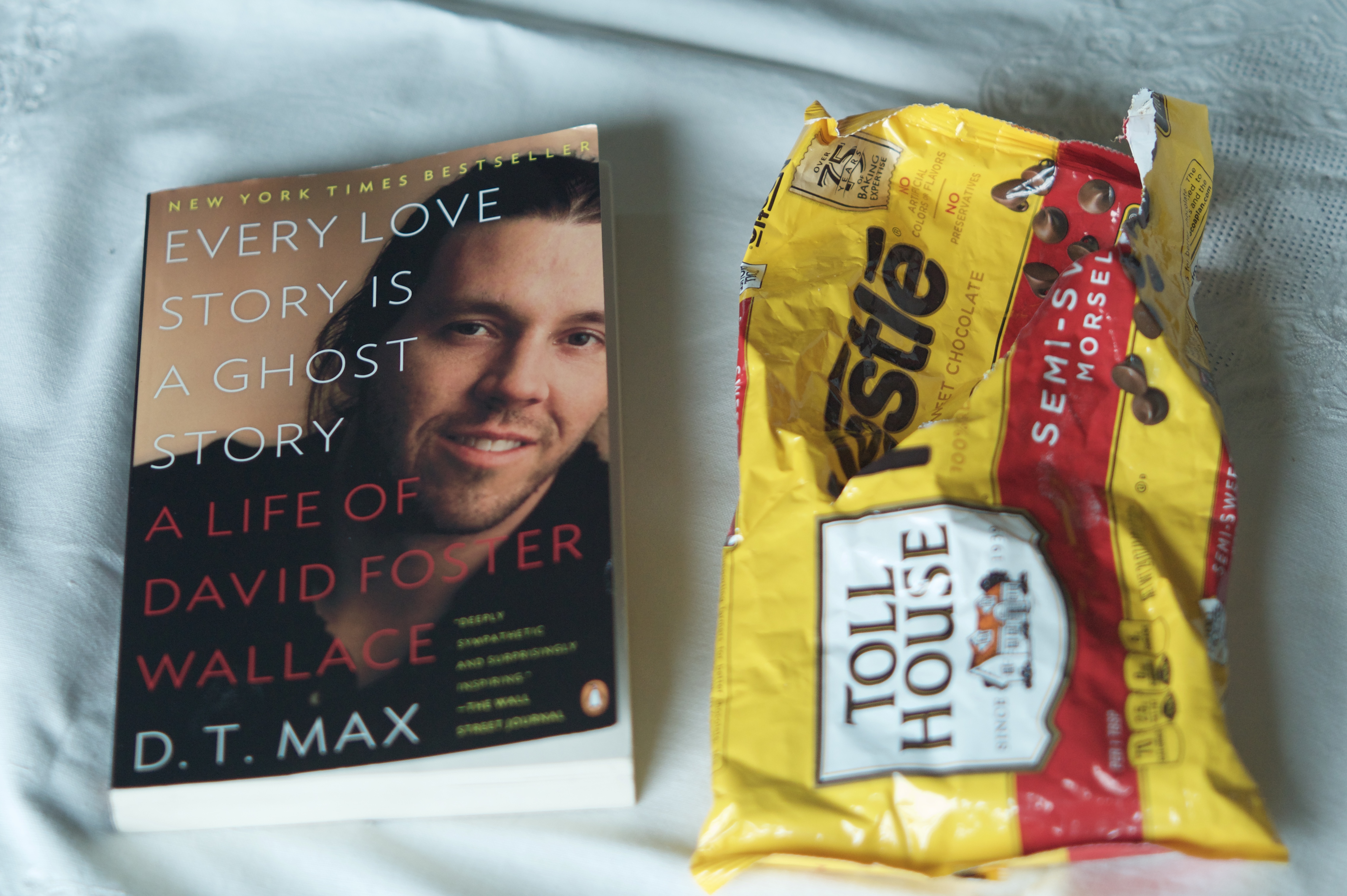 Wallace lived mainly on junk food, according to his biographer, D. T. Max. For my part, I was a noncook to such an extent that my boyfriend, fed up with making meals for me, once angrily coached me through making him a dish he called toaster-oven pizza. This involved an English muffin, a bag of grated cheese, and a jar of red sauce. I made it, but I thought he was being completely unreasonable. What I was mostly interested in back then was books and writing about them. I met Wallace because I'd transformed my dubious qualification of having read the advance proof of Infinite Jest twice into the opportunity to interview him during the book's publicity tour. The interview ran on Stim, a newfangled kind of publication that in 1996 we called an "online magazine". (That interview is still available online as part of the Wallace minor arcana and was just republished in August in an updated edition of Melville House's The Last Interview series.) The writer crush I developed on Wallace had come to me full blown when, one night reading alone in my first New York apartment, anxious and probably hungover, I sobbed my way through the end of "Westward the Course of Empire Takes its Way," the last story in the 1989 collection The Girl With Curious Hair. "Westward," seen today with the jaundiced eye of adulthood, is a creaky metafiction about students in a fiction-writing class, whose plot, to the extent it has one, is about a road trip to a McDonalds ad-campaign reunion. The main character is Mark Nechtr, a sweet Midwestern boy fiction writer who is addicted to eating fried roses. Nechtr's foil is a clever postmodernist girlfriend, who commits fictional suicide in the end (meta, complicated, story-within-a-story). Wallace later repudiated the story as "a horror show … a permanent migraine … crude and naive and pretentious," but there was also a time when he felt it was the best thing he'd ever written. Max says that upon the story's publication Wallace felt it was what he "had been born to write" and that it "said all he had to say." 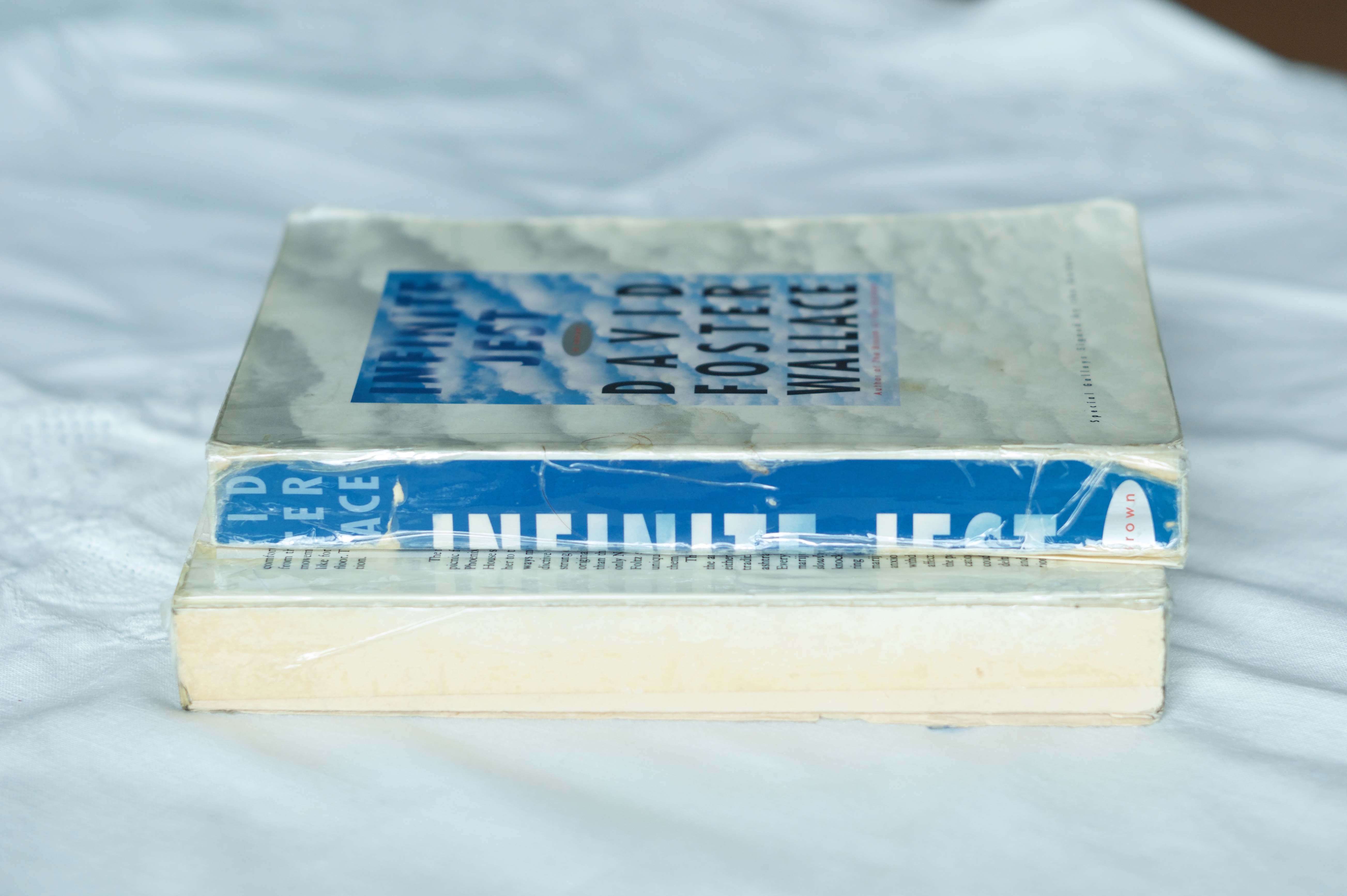 This is my signed advance reader's copy of Infinite Jest, which could have been worth fifteen hundred dollars if I hadn't ripped it in half to make it easier to carry around. That anyone could cry over "Westward" is hilarious in retrospect, but truly, I did cry. The demographic of "young women seriously upset by postmodernism" must be vanishingly small, but in the midnineties, it described me. I'd gone off to college with the squeaky overachiever's excitement to discover the meaning of life (and then, you know, apply it to what came next). To my dismay, no matter what the subject was, its underpinnings were in French critical theory, which I understood to be a poised intellectual valueless-ness and destruction of meaning. This was embarrassing, and not the kind of thing one admitted to one's friends majoring in semiotics, but it clouded my college experience in secret but real ways. Wallace, in "Westward," seemed to get it. A bit of beautiful doggerel from the story, critiquing the seminal postmodern story collection, Lost in the Funhouse, by John Barth, has run through my head for the past 22 years.
Barth's funhouse metaphor points to the infinite regression of the narrative viewpoint in fiction—even if you reveal the meta-story behind the story, you're just adding another fallible and relative layer. None of it is real. On the contrary, Nechtr, the Wallace stand-in, "desires, some distant hard-earned day, to write something that stabs you in the heart. That pierces you, makes you think you're going to die. Maybe it's called metalife. Or metafiction. Or realism. Or gfhrytytu. He doesn't know. He wonders who the hell really cares." In person, Wallace was polite and brilliant, and his answers consistently made my questions seem smarter, which was a huge relief. After the tape stopped rolling he asked me more about myself, and why I liked his work. He was pleased when I said my favorite story was "Westward" and asked if I was a Barth fan. I had to admit that I hadn't yet read Lost in the Funhouse, at which point he said scornfully, "Then what did you like, the McDonald's stuff?" I was forced to haltingly explain what I thought the story meant. At which point he said, yes, I'd gotten it, and seemed even more pleased. Eventually he gave me his mailing address in Normal, Illinois, and asked me to write him letters. Those who knew Wallace or who have read the Max biography, will be nodding their heads about now; he had a habit of availing himself of admiring young women, and his behavior has lately come under new scrutiny. The writer Mary Karr, with whom he had a relationship, has spoken out against him as recently as May this year. That wasn't my story with him, possibly because I never did write him. And when some days later, at the Infinite Jest launch party in New York City, he asked me to go back to his hotel room afterward, I left the party early instead. I saw him once more at another party, months later (in the basement of a Two Boots pizzeria in the East Village, if memory serves)—and I avoided him, even though he followed me and tried to strike up a conversation when I went outside to smoke. 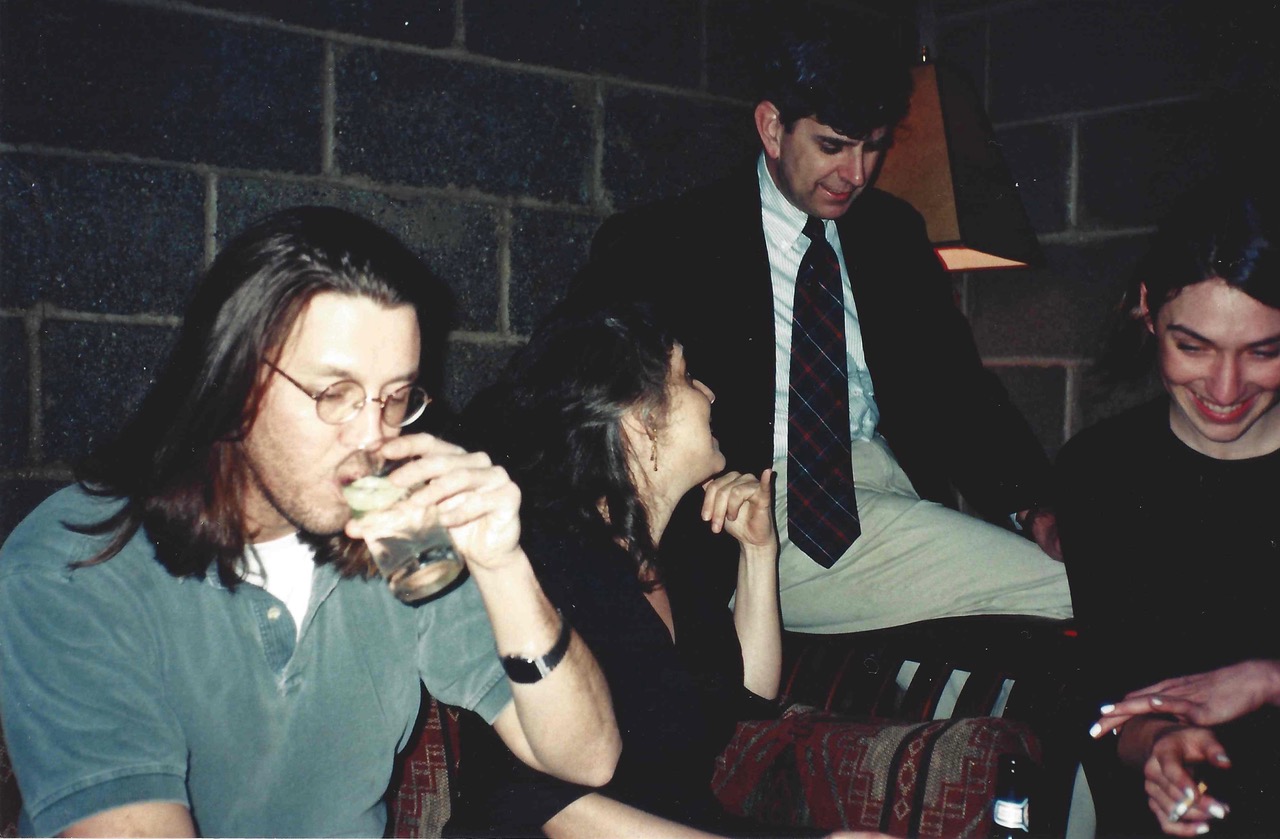 Me, far right, with Wallace, far left, at the launch party for Infinite Jest. None of these lapses were because I didn't like David Foster Wallace—on the contrary I liked him way too much. Looking back, it was an era when I just couldn't do a lot of things. I couldn't cook. I couldn't write fiction. I had just embarked on an ultimately pointless mass-media career that I would never quite believe in. Very much like a Wallace character myself, I was a child prodigy frozen by adulthood, who drank too much and often wasn't very nice to people. I let many opportunities slip by, and it's no huge surprise that I flaked on an invitation to correspond with my literary idol, or that I fled from a personal relationship that I would have liked to explore. At the time, my best guess on how to fix the things that were obviously wrong with me was to read more books. Then, possibly, I could blame it all on Foucault. Wallace never wrote another novel after Infinite Jest. The Pale King, published posthumously, was unfinished. I'm not sure how clearly it can be said that his struggles with the book contributed to his death, but any writer who has had a hard time finishing a book knows it's not great for their mental health. Wallace once called "Westward" a "suicide note," and I've found that prophetic. I've thought that he couldn't, ever, quite, snip through the Barth Mobius strip—the clever and structural game-playing girlfriend he killed in the story was himself, and the beating and un-ironic heart he sought to somehow convey in fiction (the life inside the funhouse, if you will) was hard to find, and wouldn't have been fun if he had found it. In my meandering path towards a better adulthood, I kept reading books but stopped thinking that the theories found therein were going to answer the question of how to live in the world. I've come instead to the inelegant belief that pretty much the most important thing you can do with your day is make dinner, for your family or friends if you have them, or for yourself if you don't. Do that, and the other stuff mostly falls into place. I don't know if Wallace ever learned to cook or to eat. By Max's account he was happily married, so perhaps he did. In order to cook for him, as part of the ongoing Eat Your Words column I've been doing here at The Paris Review, I couldn't make my usual kind of food. I wanted to echo the fried roses from "Westward" by stuffing and frying edible flowers. I considered doing something with corn, as a nod to his midwestern heritage and lovely "Westward" quotes like "All we've seen is corn. Its been disorienting, wind-blown, verdant, tall, total, menacingly fertile." Or "The corn is stunted right here a bit, and Mark's view goes sheer to the earth's curve: dark green yielding to pale green, to dark green, to just green…." But the man did not eat vegetables, so I couldn't do either. Instead I made blondies, which are just chocolate-chip cookie dough baked as a slab. I tried trendy brown butter and maple-pecan versions, and ended up with the classic recipe on the back of a Toll House bag, baked in a 9 x 9 pan for a satisfying chunky shape. The test batch, which I served at a children's party, was the first dessert to vanish and I was surprised to see even the adults scarfing them down. Then I made a burger because Wallace liked them (well done) and featured them in both "Westward," with its McDonald's plot and in Infinite Jest's WhataBurger tennis tournament. I made the burger as simply as possible on the stovetop, using a two-ingredient recipe and the brilliantly easy technique from Mark Bittman's classic How to Cook Everything. I could have stopped there, but the table looked lonely, so I decided to return to that long ago classic and prove that I am now a person who can make a toaster-oven pizza without crying. It seemed like something Wallace might have eaten, or cooked, or appreciated. I tried various versions, including one with red sauce from a jar, but ended up with a 'pizza' using homemade three-ingredient red sauce lifted from a Marcella Hazan cookbook (not one of her official sauces, but the easier version she includes with some recipes). I spread the sauce on a baguette, with fresh mozzarella and a pinch of oregano. It wasn't bad. I had one for lunch, and I cried again, a little, for David Foster Wallace, and for the young woman I once was. You are missed.
Mark Bittman's Basic Burger 1 1/4 lbs ground chuck -You want to handle the meat as little as possible. Shape it lightly into 4 burgers, about 4 to 5 inches across, sprinkling with salt as you do so. -Preheat a large, heavy skillet (cast iron is best) over medium-high heat for 3 – 4 minutes; sprinkle its surface with coarse salt. -Cook for 3 – 5 minutes per side, depending on preferred doneness. -Serve on a bun, garnished as you like. I used a brioche bun, plus lettuce, tomato and bacon.
Toaster Oven Pizza Serves 2. 2 tbsp olive oil
Heat the olive oil in a skillet on medium-high heat. Add the minced garlic and fry, stirring frequently, until the raw edge is off and the garlic is fragrant and beginning to turn golden, about 90 seconds. Add the can of tomatoes, stir, and turn down to a simmer. Cook for 10 to 15 minutes, until the sauce has reduced to a fairly thick paste. Spread each baguette length with 2 tbsp sauce, topped with 2-3 tbsp of mozzarella cheese and a pinch of oregano. Toast and serve.
Chunky Toll House Blondies Adapted from the recipe on the back of the Toll House bag. 2 1/4 cups flour
Preheat oven to 375. Butter a 9×9 inch baking pan. Combine flour, baking soda and salt in a small bowl. Beat butter, granulated sugar, brown sugar and vanilla extract in a large mixer bowl until creamy. Add eggs, one at a time, beating well after each addition. Gradually beat in flour mixture. Stir in morsels and nuts. Spread in the pan, and bake for 25-30 minutes, until the crust is golden and the center is set. Cool before slicing and serving.  My advance reader's poof of Girl With Curious Hair. Valerie Stivers is a writer based in New York. Read earlier installments of Eat Your Words here. The post What David Foster Wallace Ate appeared first on GuaripeteMagazine. |

 It's Wednesday! Are you ready for the weekend yet? I know I am. I have so much cleaning and unpacking to do (I was at a wedding last weekend) and I just haven't been able to get to it this week. Hopefully, you have better weekend plans on the horizon.


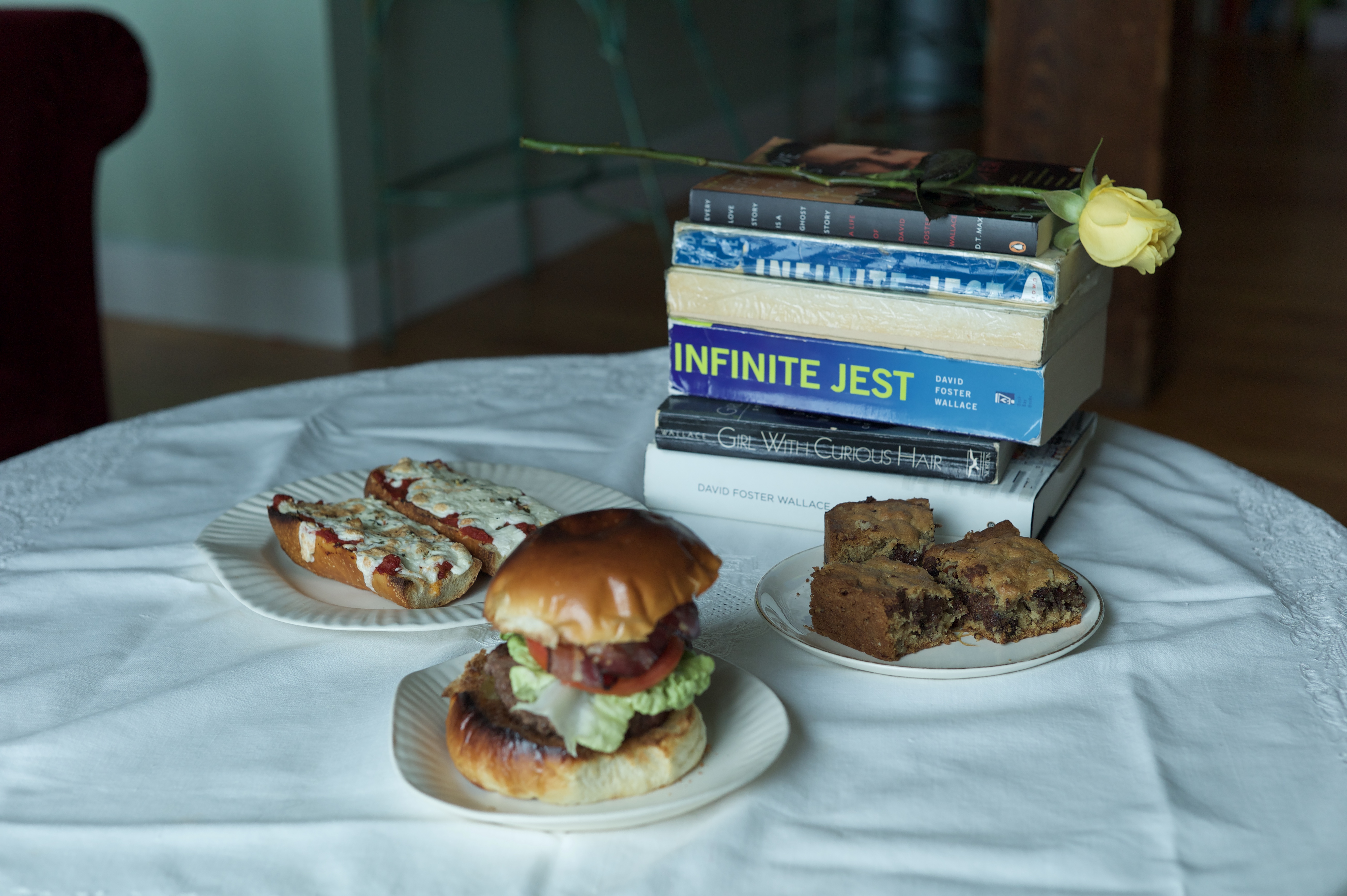

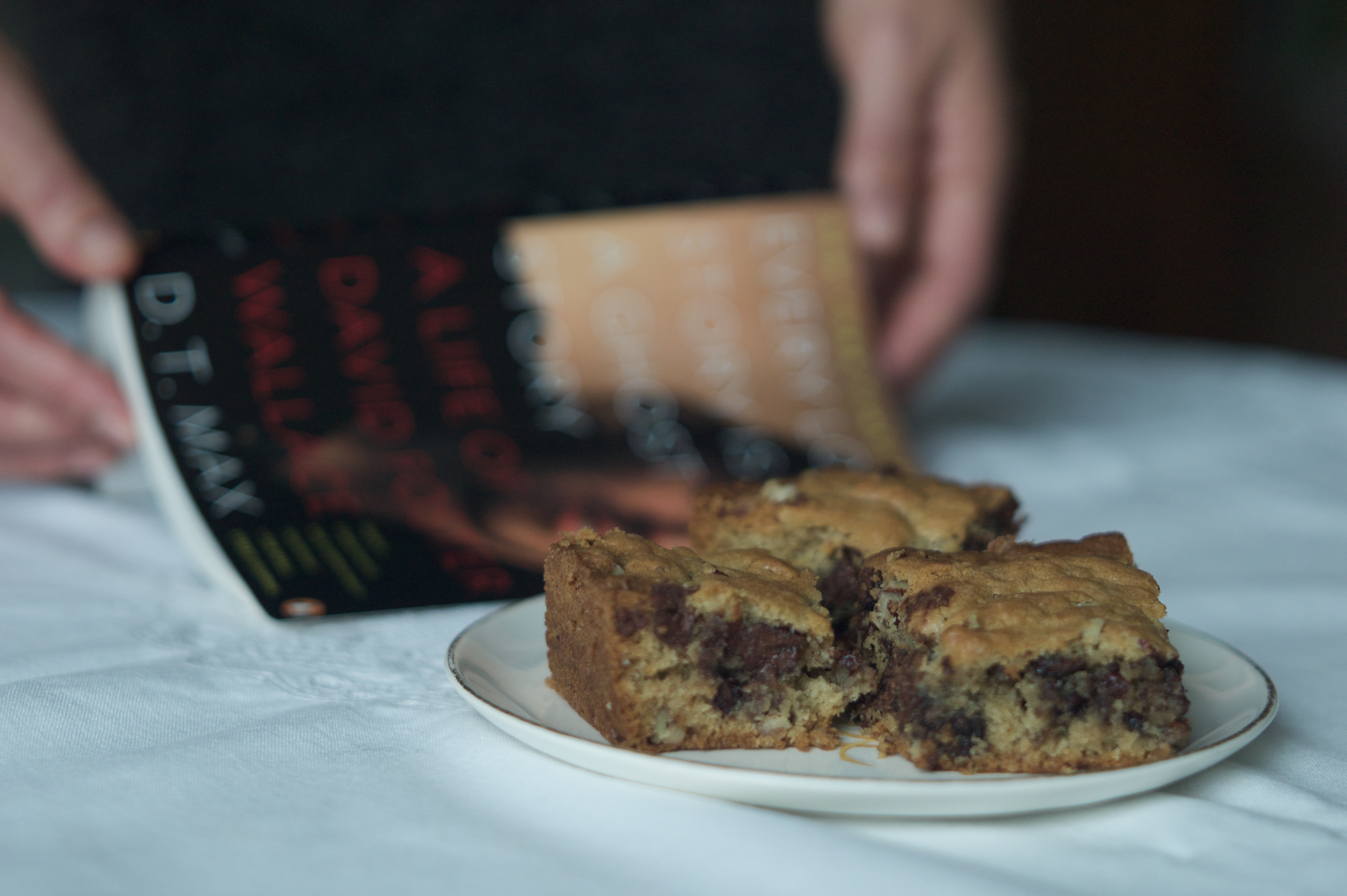

| You are subscribed to email updates from Books Trending News. To stop receiving these emails, you may unsubscribe now. | Email delivery powered by Google |
| Google, 1600 Amphitheatre Parkway, Mountain View, CA 94043, United States | |

No comments:
Post a Comment