Books Trending News – Guaripete | Online Store |
- The Rec League: Athlete Heroines
- Links: Netflix, Cheese, & Wonderwall
- A Thriller, Contemporary Romance, & More
- Homeless in Gaza
- Will the Court Kill the Gerrymander?
- Trump to Undocumented Teens: Give Birth or Get Out
- The Calla Lilies Are in Bloom Again
- Puerto Rico Sketchbook: The Radical Arts Collective
- How Do We Bury the Writing of the Dead?
| The Rec League: Athlete Heroines Posted: 11 Jan 2018 07:05 AM PST 
Sarah: The F/F guest review, with snowboarder and skier! That book stuck with me except the title because my brain. Amanda: Edge of Glory! ( A | BN | K | G | iB ) Sarah: Tamsen Parker too Redheadedgirl: Oh the skating ones! Elizabeth Harmon's Pairing Off ( A | BN | K | G | iB ) Amanda There was an Immortals After Dark with a soccer playing heroine, but the sports aspect isn't a huge thing. MacRieve was the title. There was also a hockey romance I read with a heroine who played women's hockey. Keeping Score by Sara Rider has a heroine who is a professional soccer player. I also put a great list in a recent Links post on athlete heroines. Thanks to Lacy Literacy for putting the list together! Which romances that feature athlete heroines would you recommend? Powered by WPeMatico The post The Rec League: Athlete Heroines appeared first on Guaripete. |
| Links: Netflix, Cheese, & Wonderwall Posted: 11 Jan 2018 07:05 AM PST 
… The New York Times had a really great write-up on the women who helped bring the Star Wars universe to life, both on screen and off: Kathleen Kennedy founded the group in 2012 when she succeeded George Lucas as president of Lucasfilm, putting Kiri Hart, a former film and TV writer, in charge of the unit. Ms. Hart's first move was to make the story group entirely female, starting with Rayne Roberts and Carrie Beck. Both women had experience in film development but had also worked in other arenas — Ms. Roberts in magazine publishing, and Ms. Beck with the Sundance Institute. Though I know some fans are divided on the latest movie, I hope this bodes well for women in future Star Wars creations. … For those of you who have a Netflix account, myself included (though it's really my boyfriend's but whatever!) I'm sure you've noticed that the "cover art" for movies and TV shows sometimes changes. Well, there might be a reason for that: To achieve effective personalization, we also need a good pool of artwork for each title. This means that we need several assets where each is engaging, informative and representative of a title to avoid "clickbait". The set of images for a title also needs to be diverse enough to cover a wide potential audience interested in different aspects of the content. After all, how engaging and informative a piece of artwork is truly depends on the individual seeing it. Therefore, we need to have artwork that highlights not only different themes in a title but also different aesthetics. Our teams of artists and designers strive to create images that are diverse across many dimensions. They also take into consideration the personalization algorithms which will select the images during their creative process for generating artwork. I thought it was an interesting discussion on how art meets algorithms. … Want to know what cheese pairs well with your zodiac sign? Of course you do. I, for one, am kind of disappointed with the pairing I got. I'm an Aries. … If you're searching for some new urban fantasy or paranormal romance series to read, author Chloe Neill has a huge list! HUGE! It's by no means a full, comprehensive list, but hopefully you find something there you haven't read before. … Seth Everman in YouTube is a pretty awesome musician. Seriously, I've gone down a rabbit hole of his videos many a time. He recently tested out a number of functions on his synth by playing "Wonderwall" by Oasis. I think the 90s boyband version might be my favorite. … Don't forget to share what super cool things you've seen, read, or listened to this week! And if you have anything you think we'd like to post on a future Wednesday Links, send it my way! Powered by WPeMatico The post Links: Netflix, Cheese, & Wonderwall appeared first on Guaripete. |
| A Thriller, Contemporary Romance, & More Posted: 11 Jan 2018 07:04 AM PST 
Don’t want to miss an ebook sale? Sign up for our newsletter, and you’ll get the week’s available deals each Friday. Powered by WPeMatico The post A Thriller, Contemporary Romance, & More appeared first on Guaripete. |
| Posted: 11 Jan 2018 07:04 AM PST   Mohamed Shuman playing music near the wreckage of his family's house, Gaza City, June 2015 On November 11, 2017, the gray streets of Gaza suddenly turned yellow as tens of thousands of people came out to wave the flag of Fatah, the party of their former leader Yasser Arafat. This was the thirteenth anniversary of Arafat's death, and, for the first time since 2007, when the Islamic resistance movement Hamas defeated Fatah in the bloody civil war that followed Hamas's electoral victory the previous year, it had permitted a public commemoration of Arafat Day. By allowing the celebration, Hamas had given the first substantial sign that it was serious about a new reconciliation deal, signed with Fatah in October. According to the agreement, the more moderate Palestinian faction, led by Mahmoud Abbas, which rules in the West Bank, would also assume local administrative control inside Gaza. With such a prospect, the people of Gaza hoped that Israel might be persuaded to lift the siege of the territory, which was meant to isolate Hamas and had the effect of punishing all Gazans for having voted for the party, which Israel, the United States, and the European Union consider a terrorist organization. Some Gazans have dared to hope the deal might even pave the way for tentative new discussions about wider peace. A carnival atmosphere took hold across the besieged strip during the commemoration, with children selling sweets and cakes. As the crowds packed into a central square, leaders of Hamas and Fatah promised to end their division and find unity. The people cheered but seemed fearful, too: after such a long time they were once again putting battered trust in their leadership to try to bring a resolution to the conflict with Israel. An eighty-nine-year-old woman named Aisha waved her yellow flag, tears in her eyes: "I can't breathe," she declared, "but I can cry." The sudden joyous outpouring reminded some of the euphoria that erupted in 1993, after Arafat and Yitzhak Rabin, then Israel's prime minister, signed the Oslo Accords on the White House lawn. But as Gazans know, Oslo failed to address what many of them believe was the root cause of the conflict between Israelis and Palestinians: the dispossession of Palestinians during the Arab–Israeli war of 1948, during which the Jewish state was created. Oslo proposed to reverse Israel's illegal land seizures of 1967, offering a "two-state solution," with the Palestinian state constructed out of Gaza and the West Bank, joined by a safe passage across Israel, and East Jerusalem as its capital. But the negotiators did not address the long-standing claim of Palestinian refugees that they have a right to return home. Nowhere is that right as deeply felt as it is in Gaza, which holds the highest concentration of Palestinian refugees, many living within a few miles of their pre-1948 homes. A slice of land just twenty-five miles long and seven miles across at its widest, the Gaza Strip sits at the southwest tip of Israel, bordered to the west by the Mediterranean, to the south by Egypt, and to the east and north by Israel. The other chunk of Palestinian territory, the West Bank, lies fifty miles away, with Israeli territory in between. Until 1948 there was no "Gaza Strip"; the area around Gaza City was part of a much larger region of British-ruled Palestine known as the Gaza District, which contained scores of Palestinian villages. During the 1948 war a total of 750,000 Arabs fled or were expelled from all over Palestine. About 200,000 of those living in the south sought refuge in the Gaza City area, which Egypt had seized during the war. In December 1948 the United Nations passed UN Resolution 194, stating that the Palestinians should have the right to return to their homes, but Israel's first prime minister, David Ben-Gurion, refused, saying that Palestinians would "never return." Within a few years Israel had erased almost every Arab village in the former Gaza District. "The old will die and the young will forget," Ben-Gurion is said to have declared. The Arabs of Palestine, however, have not forgotten the events of 1948, which they refer to as the Nakba, or catastrophe, and they have been working harder in recent years than ever before to preserve the memory of their lost homes. Ben-Gurion also expressed the hope that the refugees would move away from camps near Israel's border and disperse into Arab countries, but while some did move away, most have stayed in order to be close to their land. The original 200,000 refugees who fled to Gaza now number up to an estimated 1.7 million. (Each descendant of a refugee is also classified by the UN as a refugee.) And with them in the Strip live another 300,000 Palestinians, indigenous to Gaza. Today more than two million people live in Gaza, which is surrounded by walls and fences patrolled by Israeli soldiers. Israeli drones fill the skies above, its gunboats patrol the sea. On Gaza's southern border is the Rafah crossing into Egypt, usually closed because Egypt has cooperated with Israel's siege. The only point of entry from Israel for human traffic is the Erez checkpoint, on Gaza's northern border. Yet even while making that crossing it's hard to believe anyone lives on the other side. The only other people passing through with me on a recent visit were a group of British surgeons from the charity IDEALS, their suitcases packed with prosthetic limbs. Inside Gaza, the medieval and the modern seem to coexist, as horses and carts crowd the streets along with cars and trucks, while children in pristine uniforms pour out of schools. A new UN school is built each month in order to accommodate the population growth. In the middle-class Rimal area, students speaking into mobile phones struggle to be heard over hawkers selling wares. Shops seem well stocked, but prosperity is an illusion, since many of the luxury goods have been smuggled through tunnels from Egypt and hardly anyone can afford them. Thundering generators struggle to provide emergency power as Gaza itself struggles to survive the siege while still rebuilding after recent wars. The Israeli assault of 2014 lasted fifty-one days and killed 2,200 people, including five hundred children, as well as destroying thousands of homes, schools, water plants, and hospitals. Israel lost sixty-six soldiers and seven civilians during the conflict. The UN says that Gaza will be uninhabitable by 2020. Sitting on stones by the seafront with Emad, my twenty-five-year-old Palestinian driver, we could see why: raw sewage was pouring out into the water, the electricity cuts having crippled the sewage system. Emad pointed out that the stones we were sitting on carried the names of Palestinian villages destroyed in 1948. He was sitting on Majdal, where his family came from. He looked up the coast to the swinging cranes of the thriving Israeli port city Ashkelon, built on the spot were Majdal once stood. I was sitting on a stone named Huj, a village just a few miles from Gaza. Many areas and streets in Gaza are named after villages the residents once lived in. A man Emad and I met named Ali Abu Aleish, who lives on Huj Street, produced documents showing that his family owned land that is now part of an estate constructed by Ariel Sharon, the deceased former prime minister of Israel. In view of Gazans' daily struggles, it seems surprising that they have time to think of the past. But it is precisely because of recent wars that memories of 1948 have been strengthened. The bombardment of Gaza in 2014 caused people to feel that a "second Nakba" was occurring. I first heard the phrase soon after that war from an old man named Abu Ibrahim, who was sitting on the pile of rubble that had recently been his home. His family had herded sheep around Beersheba for centuries, and in the war of 1948 they were forced to flee, first living in a tent, then building a house near Gaza's border, from which they could see their old land. He showed me an urn his mother had carried on her head from Beersheba; the urn had survived the first and second Nakba, he said proudly. Ibrahim's reference to the second Nakba was echoed up and down Gaza. The destroyed houses, the panicked flight, the tents in which the homeless had to live—these have reminded many of what happened seventy years ago. In the aftermath of the 1948 war, the refugee tragedy caused headlines and protests around the world, but the story soon faded from view. The Israeli government told the world that Palestinians had fled their villages of their own accord or on orders from Arab armies that wanted them out of the way. There was no obligation on Israel, therefore, to let Palestinians return, since, according to this argument, their displacement was not Israel's responsibility. Any "infiltrators" who tried to go back were criminals, and they were shot or put in prison. With the US standing behind the new Jewish state, Palestinian accounts of 1948 were too often ignored. In the late 1980s Israel's so-called new historians, most notably Benny Morris, examined newly opened Israeli archives and found no evidence that the refugees had fled on orders from Arab leaders, but had done so mostly out of terror after hearing reports of massacres carried out by Israeli soldiers in villages such as Deir Yassin, where Jewish militiamen killed over 150 Palestinian civilians. Ilan Pappé, another of Israel's new historians, went further, identifying what he called a plan of "ethnic cleansing." By this time, however, Israel's official narrative of 1948 was so entrenched that the voices of these new historians were barely heeded by politicians, and in the 1990s it was considered impossible to secure Israeli support for the Palestinian right of return. Even Arafat agreed to set it aside during the Oslo talks. Today many Palestinian analysts blame Arafat, as well as Israeli and Western negotiators, for Oslo's failure, warning that a newly unified Palestinian leadership will not remain unified for long if it doesn't insist on addressing the right of return in any new peace talks. "During the Oslo process the right of return was relegated as if a mere irritant, not a fundamental human right," said Ramzy Baroud, the son of a 1948 Gaza refugee, editor of The Palestine Chronicle and author of the forthcoming book The Last Earth: A Palestinian Story.* "The collapse of the peace process and the failure of Oslo brought the right of return back to the center." In Israel, however, where the policies of the extreme right-wing have received endorsement from Donald Trump, particularly through his stunning recognition of Jerusalem as Israel's capital, the prospects of putting a Palestinian right of return on a negotiating table seem more unlikely than ever; the mere mention of it is enough to destroy the possibility of a rapprochement. Even the dovish Yossi Beilin, an architect of Oslo, says the two-state approach remains the only option: "The right of return will never happen. All this talk of '48 is a mood, not an opinion."  Palestinians posing for selfies on a pier by the Mediterranean Sea, Gaza City, March 2017 Some Palestinians agree with Beilin. "Palestinians always claimed their rights to historical Palestine," said Ghassan Khatib, professor of politics at Birzeit University in the West Bank. "Then someone came along and convinced them that this was utopian and would not happen, offering a trade-off to go for the possible instead. Now people realize the possible and the impossible are both impossible, so they might as well stick to the impossible. But they have no strategy, no plan." Gaza's own "new historians," however, like Salman Abu Sitta, founder of the Palestine Land Society, which maps pre-war Palestine, say the prospects are not hopeless. "The conflict began in 1948, not 1967. It cannot be solved without returning to the root cause," said Abu Sitta, who fled the Gaza District as a child. And there is a Palestinian plan, he said, which is to win back ground in the narrative war by challenging Israel's version of the 1948 war. A form of peaceful resistance, this campaign of retrieving the facts is already well underway, he said, largely thanks to the younger generation of Palestinians. In Gaza more than 60 percent of the population is under the age of twenty-five, and it is among the young that the deepest despair often takes root. Some are turning to radical Islam, others to drugs. As many as eighty suicides are reported in Gaza each month, according to local aid groups, many among the young. Most of Gaza's younger generation have nevertheless remained remarkably resilient, preparing against the odds for a better future, while also making an effort to learn about their past. Earlier this year I encountered this resilience at a Gaza girls' school, where I met with a class of seventeen-year-olds preparing for final exams. All had plans to study further in order to become doctors, social workers, journalists, and lawyers—"anything that helps free Gaza," as one said. I asked how many had lost family in the war, and at least ten hands shot up. "Why did Balfour give away our land?" asked one girl, referring to the declaration made in 1917 by Arthur Balfour, then British foreign secretary, pledging to create in Palestine a Jewish homeland. "Why did the world not implement UN Resolution 194 [the Palestinian right of return]?" "Why should I be a refugee when my land is one kilometer away?" Their teacher explained to me that schools were placing more emphasis than ever on teaching history, studying the pre-1948 villages and the Nakba, since it helped the children understand the present. "They have lived through three wars"—in 2008, 2012, and 2014. "They want to understand how this can be. Their parents don't have answers but if they can learn their story from the beginning they can make their own minds up and find connections to the present." The teacher herself had lost her father in the most recent war. "He survived 1948 but was killed in 2014," she said. Many of the young are profoundly disillusioned with Palestinian politics, openly scorning the "old men," as they call leaders of both Hamas and Fatah who have failed to find solutions for their generation, preoccupied instead with internal squabbles. Despite the unity displayed on Arafat Day, few young Gazans believe the reconciliation agreement will hold, saying that the only way to bring Palestinians together is around the issue of 1948. "At a popular level Palestinians everywhere including citizens of Israel are resurrecting these '48 values in response to divisions of their leadership. It is an issue that unifies everyone," said Ramzy Baroud. Talking of 1948 certainly unifies Gazan families as they live under siege. In Shati refugee camp, power cuts force families to sit together in the dark, often passing the time by listening to a grandparent describing life in his or her old village, which appears so much better than life today. "In summer I ran into the long grass or lay in the cool orange groves," said Fatmeh Tarqash as her children and grandchildren listened. "In winter we built a fire and took the embers indoors for warmth." Fatmeh's grandchildren have nowhere to run today. In winter the asbestos-roofed homes in the camps are cold and damp, and in summer the walls sweat. Fatmeh's twenty-two-year-old granddaughter, who works with people whose hearing has been impaired by explosions, listened carefully, and then exclaimed: "They grew their own food. They were self-sufficient. But today we must be beggars." She pointed angrily to a UN food box. When the electricity to the house suddenly came back on she showed me her family's old village on Google Earth. Would she settle for a two-state solution? "No. If they give us part of the land back, they will expect us to be grateful to them. Why should we be? It's ours." Gazans have a new tool in their campaign to raise awareness about their dispossession: the Internet has allowed them to bring their erased villages back to life by posting photographs of documents and land deeds. Gaza's "new historians" are also journalists who contribute to the Electronic Intifada and other burgeoning Palestinian news sites. A young journalist, who didn't wish to be named, films close to Gaza's northern border and streams his footage of Gazan fishermen being monitored by Israeli gunboats as they haul in a catch. "We live in a box," he told me. "A fake place. We want to show people what it's really like and not rely on others to tell our story." New technology also allows the young to look to the future. At the Islamic University of Gaza, architecture students redesigned their ancestral villages as futuristic cities for a competition to be judged in London. One showed a Palestinian town that had been destroyed in 1948 rebuilt with skyscrapers and huge highways. A month later I saw the finalists' drawings posted on the wall of a London art gallery, where the participants joined us from the West Bank and Gaza via Skype. Talk of construction rather than destruction was moving, but these futuristic designs for Palestine after "the return" seemed fanciful. It is unlikely that construction by Palestinians on land recognized as theirs will begin anytime soon. After all, it is Israel that is carrying out the construction by building settlements across Jerusalem and the West Bank. Israel is increasingly intransigent about granting any land at all, even in the West Bank, where illegal settlement continues at speed, as it does in Arab East Jerusalem. Yet some new ideas for a resolution are emerging, particularly among the new generation of Palestinians who talk about a one-state solution with Jews and Arabs living as equals in a single democratic state on all of mandate Palestine. Among Israeli Jews today this prospect seems especially fanciful, but some Israeli radicals predict it must come. Ilan Pappé, speaking in Cambridge recently to launch his new book, The Biggest Prison on Earth, said that the one-state solution was "not an impossible scenario" and that the alternative is for Israel to continue developing as "an apartheid state." Although the concept of a one-state solution is still in its infancy, we are certain to hear more about it, precisely because the prospects for two states seem dead. The one-state idea is already being discussed within senior ranks of the moderate Palestinian Authority. Saeb Erekat, the chief negotiator for Mahmoud Abbas, responding to Trump's Jerusalem move, declared that by recognizing the city as Israel's capital, Trump had finally killed the two-state idea, adding: "Now is the time to transform the struggle for one state with equal rights for everyone living in historical Palestine from the river to the sea." There is even a smartphone program called the iNakba app that provides maps indicating where Palestinian villages once were and what Israeli towns might be there now. Driving across Israel to reach Gaza, I used the app as a guide back in time, passing the site of the Palestinian village of Yibneh, which is now Yavneh. Near the huge Israeli port of Ashdod lie the remains of Isdud, where a Gazan friend of mine, Abu Hasan, once lived. On a recent visit to Gaza he told me how to find his house, but it was no longer there. Almost all traces of the Palestinian villages have disappeared. A woman I met in Ashkelon, who had recently emigrated from Ukraine to Israel, had never heard of Majdal, which had been a thriving textile center before 1948. "There were never any Arabs here," she told me. "It's a lie." The iNakba app revealed that the Arab market that still stands in Ashkelon's Old City was once the main market of Majdal. There are some signs that Palestinians are gaining ground in their narrative war. They have new allies inside Israel, where a small number of young Jewish Israelis are helping Palestinians excavate their history. A group called Zochrot ("remembering," in Hebrew), a nonprofit organization formed in 2002, aims to "raise awareness of the Palestinian Nakba." Zochrot devised the iNakba app. Israel's "official historians" have gone on the defensive, busying themselves with reclassifying sensitive historical files, held in Israeli archives, relating to 1948. Benny Morris found that among the reclassified files were those relating to the massacre at Deir Yassin. Morris first saw the documents in the 1980s, but said that "the Defense Ministry offered no explanation" for why they have been reclassified. Whatever small gains the Palestinians are making in their narrative war, however, they are under no illusion about the monumental task they face if their objectives are ever to be achieved. At a café in Gaza, the author Dr. Mohammed Bugi expressed skepticism. "We need a new Mandela," said Bugi, recently banned from traveling to Amman to promote his new book on pre-1948 Yibneh. "And a new de Klerk," said Fayez Sersawi, an artist whose studio was bombed in 2014. "Now they are trying to crush our culture and shut our history down. The Nakba has never stopped. The patterns just repeat themselves." At Rafah, a border town on Gaza's southern tip, the repeated patterns of the conflict are highly visible. Camps here are named after the old villages—Yibneh, Isdud, and Huj—and have been regularly bombed in recent times, just as the villages were in 1948. Rafah's streets are full of posters of martyrs; its camps have always produced the most determined resisters, including suicide bombers. Many of them—including some who were responsible for the carnage across Israel during the Second Intifada, which erupted in 2000 in the despair that followed Oslo's collapse—were descendants of those who arrived in 1948. Close to the Egyptian border, where the Sinai sands sweep into Gaza, small plastic shelters cover openings of tunnels being dug into Egypt, though in recent months Israel has begun working on a new underground wall, sunk deep into the desert, to block off such tunnels. Nearby on Rafah's beach is a jumble of shacks, home to fishermen, descendants of villagers from Jura, once a thriving fishing community just up the coast. History is about to repeat itself for the people of Jura whose refugee dwellings lie in the path of bulldozers clearing the area to create a wider buffer zone. Most residents of Rafah, so exposed here on the border, have suffered too much as a result of the conflict to wave flags for Arafat or anyone else. Those I spoke to did not express hope for the near future, often saying in chilling terms that "something worse than the Nakba" is about to happen. And yet they also know that in Gaza a change of mood—too easily dismissed by Yossi Beilin—can be the harbinger of change. When the mood in Gaza changed in 1987, it led to the First Intifada, which in turn led to the first moves toward peace negotiations. Even in Rafah the renewed attention being given to the Nakba has also spread a kind of confidence, a sense that one day the refugees' story will be known and the injustice they have suffered recognized. The very fact that evidence of the Nakba is now preserved online, the history now already widely available, has contributed to this confidence. While in Rafah I visited my friend Abu Hasan, whose erased village I had searched for on my drive to Gaza, and I told him I'd failed to find his house. He was not surprised, but expressed the view that the Nakba would not be forgotten. He had just completed his own history of his village. "How can our Nakba—our catastrophe—be forgotten? For us it continues every day," he said. "What would you think if you were told you had to leave your home one day and suddenly abandon everything you'd ever loved and known and never go back. Would you forget?" Was he still expecting to go back to Isdud? "I go back every night. In my dreams I go back and play among the trees and chase the birds. Perhaps I won't go back myself. I'm very old. And Isdud won't be like I knew it. But Palestinians will go back one day, I'm sure." —December 20, 2017 Powered by WPeMatico The post Homeless in Gaza appeared first on Guaripete. |
| Will the Court Kill the Gerrymander? Posted: 11 Jan 2018 07:04 AM PST   Paolo Uccello: St. George and the Dragon, circa 1470 On Tuesday, a panel of federal judges struck down North Carolina's congressional map, ruling it an unconstitutional partisan gerrymander. State Republicans had drawn district lines with such ruthlessness that they had won ten out of thirteen seats in the 2016 election—77 percent—even though they got only 53 percent of the vote. GOP lawmakers, wrote Judge James Wynn Jr., had been "motivated by invidious partisan intent." Republicans had openly admitted as much. "Nothing wrong with political gerrymandering," declared one of the lawmakers leading the process at a 2016 hearing. "It is not illegal." The GOP is likely to appeal Tuesday's ruling to the Supreme Court on those grounds. Whether courts are empowered to block partisan gerrymanders—as opposed to gerrymanders involving racial discrimination, which just about everyone agrees are unconstitutional—is a question the justices considered in October when they heard Gill v. Whitford, a challenge to Wisconsin's state assembly map. The fate of North Carolina's map likely hangs on how the court decides Gill. A ruling is expected before the end of June. There's much more at stake, too. An opinion in Gill that significantly reduces partisan gerrymandering could radically reshape the redistricting process for this decade and the next, with major implications for the fight to control both Congress and state legislatures. But it also could help fix America's increasingly embattled democracy. Gill and the enormous gerrymander from which it emerged underscore how the justices' failure to act when they last had the chance, over a decade ago, has warped American electoral politics almost beyond recognition. Essentially, it has allowed Republicans to turn the last three elections for Congress and many statehouses into a strange simulacrum of competition, in which the parties compete vigorously for votes even though GOP control has often been all but assured from the outset. At stake in Gill, ultimately, is the question of whether election outcomes can be made once again to provide at least a rough reflection of the popular will. * States must redraw their congressional and state legislative maps after every census, which takes place in the first year of each decade. Before the 2010 mid-term elections, Republicans poured resources into the battle for control of important state legislatures in order to gain power over the redistricting process that would follow. They emerged with full control of state government in crucial redistricting battlegrounds like Florida, Texas, Ohio, Virginia, North Carolina, Pennsylvania, Michigan, Wisconsin, and Alabama. Then, they set about rigging the maps. American political parties have been drawing district lines in their favor at least since Massachusetts Governor Elbridge Gerry's famous 1812 map, which aimed to boost his Democratic-Republican Party and included the notorious salamander-shaped district from which the term "gerrymander" derives. But by 2011, Republican map-drawers had access to software exponentially more sophisticated even than that used by states like Pennsylvania a decade earlier. This allowed them, with unprecedented precision, to distribute Republican voters more efficiently than Democratic ones. They did so by grouping Democratic voters together into a small number of ultra-safe districts with clear Democratic majorities (it helped that Democrats already tend to cluster in cities), while creating a much larger number of districts that leaned Republican—by less extreme margins than the Democratic ones, but still by enough that the GOP was largely assured of winning them. In the next election, in 2012, Democratic candidates for Congress won more votes than Republican candidates in Pennsylvania, North Carolina, Michigan, and Wisconsin, yet in all those states the GOP came away with more House seats. (In Pennsylvania, Republicans won thirteen out of eighteen seats with less than 49 percent of the vote.) Nationwide, Democrats won 1.4 million more votes in congressional races than Republicans, but came away with thirty-three fewer seats. Stated bluntly, voters in 2012 wanted a Democratic Congress but got a Republican one, with the result that President Barack Obama's legislative agenda was stymied for two more years of his presidency than it would have been in a system that accurately reflected voters' collective preferences. In the two elections since then, Republicans' share of seats has again significantly exceeded their share of votes in both congressional and state legislative races. Now, with President Trump deeply unpopular, Democrats are expected to pick up seats in the mid-term elections of November 2018. But thanks to the rigged map, analysts say, they'll need to win about 55 percent of the vote nationwide to carry a majority of House seats in Congress. Besides clearly thwarting the will of voters, the Republican gerrymander has reduced the number of competitive districts, contributing to declining turnout as would-be voters come to feel, often with reason, that their voices don't matter. And there is evidence that it has contributed to the growing extremism of the Republican congressional caucus by creating so many safe Republican seats, whose holders have more to fear from a primary challenge than from the general election. This manipulation has felt particularly threatening to the integrity of US democracy because it's only one way among several in which the right to meaningful political participation for ordinary Americans is being undermined. Over the last decade, extreme gerrymandering has coincided with state-level voter suppression laws that have largely targeted minorities and marginalized groups; with the evisceration of campaign-finance laws, giving outsized influence in elections to corporations and the super-wealthy; with the violation of longstanding congressional norms, which saw, for example, the Senate fail to vote on Merrick Garland's Supreme Court nomination; and even with the growing significance of the Electoral College, which twice in the last five presidential elections has handed the White House to the candidate who lost the popular vote. Together, these trends have threatened to create a sense that America's democratic system is dangerously unable to fulfill its prime function of translating the preferences of voters into political and policy outcomes.  The cartoon by Gilbert Stuart that coined the term "gerrymander," showing Massachusetts's electoral district in 1812; Stuart's friend called it a 'Gerry-mander,' a cross between a salamander and Massachusetts Governor Elbridge Gerry, who approved rearranging district lines for political advantage Back in 2004, the Supreme Court heard Vieth v. Jubelirer, a challenge to Pennsylvania's congressional map, through which Republicans had essentially guaranteed themselves at least 60 percent of congressional seats for the next decade, even if Democratic candidates got more votes statewide. The map rendered the will of Pennsylvania's voters irrelevant. The court's four liberal justices voted to strike the map down as an unconstitutional partisan gerrymander. The four conservatives voted to uphold it, saying that finding a legal standard to determine when a partisan gerrymander goes too far is impossible. Justice Anthony Kennedy was the swing vote, and in the end, he did what he often does: he sided with the conservatives while seeming to throw the liberals a bone. Kennedy said it might still be possible to come up with a legal standard for partisan gerrymandering in a future case. But he rejected the standard used by the plaintiffs in Vieth as arbitrary, and so upheld Pennsylvania's map. Since then, legal scholars, political scientists, and statisticians have been developing a standard for identifying unconstitutional partisan gerrymanders that will satisfy Kennedy. Gill uses a standard that, gerrymandering opponents hope, may finally convince Kennedy to vote in their favor: the efficiency gap. Developed by Nicholas Stephanopoulos, a law professor at the University of Chicago who was among those representing the Gill plaintiffs, and the political scientist Eric McGhee, the efficiency gap compares each party's number of "wasted" votes—that is, votes that went to a losing candidate, or that went to a winner but weren't needed for victory. The larger the gap between the two parties' total number of wasted votes, the greater the advantage the map gives one party. Wisconsin Republicans drew their most recent maps during a snow storm in February 2011. They did so not in the state capitol building in Madison, but across the street in the conference room of a friendly law firm—the better to invoke attorney-client privilege and shield the process from public scrutiny. The result was roughly comparable to the Pennsylvania congressional map that Justice Kennedy had reluctantly approved in 2004. Even though Democratic candidates for the Wisconsin assembly got more votes than Republicans statewide, the GOP wound up with five out of eight House seats in the 2012 election. "There is close to a zero percent chance that the current plan's efficiency gap will ever favor the Democrats during the remainder of the decade," said Stephanopoulos and McGhee of the Wisconsin assembly map, in a calculation cited by a federal district court. During oral arguments, the Supreme Court's four most conservative members did not sound convinced. Justice Neil Gorsuch likened the formula for the efficiency gap to his steak rub: "I like some turmeric, I like a few other little ingredients, but I'm not going to tell you how much of each." Chief Justice John Roberts dismissed it as "sociological gobbledygook." And, famously concerned about the court's reputation, the chief justice fretted that intervening in a case with such clear partisan implications would be seen by "the intelligent man on the street" as an effort to help one party at the expense of the other, causing "very serious harm to the status and integrity of the decisions of this court." (Why, despite the court's conservative, Republican-appointed majority, this hypothetical intelligent man would be likelier to see partisan bias in a ruling to intervene, benefiting Democrats, than in a ruling not to, benefiting the GOP, was left unexplained. Maybe the man wasn't as intelligent as Roberts thought.) But Kennedy sounded much more open to the challengers' view. While asking nothing at all of the plaintiff's lawyer, he grilled Wisconsin's solicitor general with tough questions that hinted he may see extreme gerrymandering as a violation of a voter's right to freedom of association found in the First Amendment, of which he is famously protective. Another development could also augur well for gerrymandering opponents. In December, the justices unexpectedly announced they would hear a second redistricting case, this one a challenge to a single congressional district drawn by Maryland Democrats. Why the court agreed to hear the Maryland case, which raises similar issues to Gill, isn't yet clear. But several court-watchers, noting Roberts's concerns about the court being seen as partisan, have offered a plausible theory: there may already be five votes for the plaintiffs in Gill, and the chief justice is more likely to join the majority in a decision that hurts Republicans if he knows the court has a chance to demonstrate its nonpartisanship by also striking down a district in Maryland that was drawn by, and favors, Democrats. * A result along those lines could have almost immediate repercussions. It would boost the plaintiffs not only in the North Carolina case, but also likely in a challenge to Texas's maps. But the real impact of a Supreme Court ruling would be felt when the next redistricting cycle begins, after the 2020 census. A clear statement by the court against partisan gerrymandering would empower lower courts to strike down the most egregious maps, and would probably also convince lawmakers and their map-drawers to act with more caution. Even leaving Gill aside, there are signs that the upcoming redistricting cycle may not repeat the worst excesses of the previous one. For one thing, Democrats won't be caught sleeping again. They've already launched an aggressive effort, led by former attorney general Eric Holder, to win control of the major redistricting battlegrounds in 2020, which would mean that fewer states than last time are likely to be under the one-party rule that ruthless gerrymandering requires. Holder's group also plans to support efforts to have independent commissions take over the redistricting process. In fact, in a supreme irony, Republicans may be about to experience the downside of extreme gerrymandering. In order to most efficiently distribute their voters, they created a large number of districts with slightly more Republicans than Democrats, while creating very few ultra-safe Republican districts, since doing so would have wasted Republican votes. That strategy made sense for most election years. But now, the expected Democratic wave in this year's midterms could put in play all those weakly-leaning Republican districts. Some experts predict a "wave election," in which Democrats could gain as many as seventy-five seats. The Republican gerrymander of earlier in the decade could end up making a Democratic resurgence even more powerful than it would otherwise have been. Still, the GOP may attempt to politicize the upcoming census itself, on whose data redistricting relies. The administration is now looking to add to the survey a question about citizenship, which civil-rights advocates fear could chill response rates from non-citizens. Among other troubling results, that could lead to redistricting plans that reduce the power of minority communities and boost that of white ones. And for the Census Bureau's top operational post, President Trump is reportedly considering Thomas Brunell, a Republican defender of gerrymandering who wrote a book entitled Redistricting and Representation: Why Competitive Elections are Bad for America. Gill may lead to a fairer, more democratic redistricting process. But with Republicans doing all they can to maintain a hold on power as America's demographics rapidly change, it's unlikely to be the end of the story. Powered by WPeMatico The post Will the Court Kill the Gerrymander? appeared first on Guaripete. |
| Trump to Undocumented Teens: Give Birth or Get Out Posted: 11 Jan 2018 07:04 AM PST   Protesters with Planned Parenthood supporting the right to an abortion for "Jane Doe," a pregnant minor being held in a Texas facility for unaccompanied immigrant children, Washington, D.C., December 21, 2017 At the core of the anti-abortion movement is the tenet that a fetus is a person whose rights need to be protected. This is how anti-abortion activists justify "heartbeat bills" restricting when women can terminate pregnancies and picketing clinics. The fetus, they argue, deserves the legal consideration due to any human being. Now, the Trump administration is taking this argument to an absurd and cruel extreme. A fetus in the United States requires the full protection and support of American law. As for its undocumented, adolescent mother—well, if she wants her rights, she should leave the country. Last year, a teenage girl subsequently identified in court documents only as Jane Poe crossed into the United States and was caught by border authorities. She had been raped in her home country, and learned that she was pregnant. She wanted to have an abortion. An acquaintance offered to serve as a sponsor, which would allow her to leave the shelter in which she has been detained while she waited for immigration proceedings. Jane Poe hesitated. She worried that the potential sponsor and her mother would beat her if she tried to end the pregnancy. She asked the shelter to allow her to have the procedure. She was not in a state that required parental consent for a minor to have an abortion and she was legally entitled to the medical help. But the shelter refused, and the young woman couldn't leave without staff approval. Government shelters are locked and closely watched; the movements of their inhabitants are tracked. The young woman tried to kill herself. Jane Poe's case is the third in a recent disturbing pattern among undocumented minors in custody who have been denied abortions. These cases are now subject to a class-action lawsuit led by the ACLU. The Office of Refugee Resettlement (ORR), the agency within the Administration for Children and Families responsible for housing young people who come across the border, is led by an anti-abortion activist appointed by Trump, Scott Lloyd. Lloyd has made it a policy to block undocumented pregnant minors from getting abortions, personally intervening to discourage and dissuade these "unaccompanied alien children," or "UACs," as he calls them, from taking an action he views as "violence against an innocent life." In so doing, Lloyd has advanced the Trump administration's attacks on both the rights of women and the rights of undocumented people. Lloyd has little qualification to lead the agency, except that his extreme views on women's health align with those of many in the administration. Before he worked at Health and Human Services (HHS), Lloyd actively campaigned against abortion. He has been on the board of a crisis pregnancy center, a type of institution that masquerades as an abortion clinic and provides false information designed to discourage women from terminating pregnancies. He has suggested that women who receive contraception be forced to sign a pledge not to have an abortion, and has argued that access to abortion hinders men's rights. "Contraceptives are the cause of abortion… I know this is counter-intuitive, but it is only so because Planned Parenthood and other population control entities have been successful in spreading misinformation for so long," he wrote in an article for the blog Ethika Politika in 2011 while serving as a lawyer for the Catholic anti-abortion group LegalWorks Apostolate. In March, shortly before Lloyd took his position, the ORR announced that the director of the agency would need to personally approve any abortion required by a pregnant teenager. Lloyd then ordered staff to direct young women who wanted to end pregnancies to crisis pregnancy centers rather than to doctors. In at least one case, he personally contacted a pregnant teenager to pressure her out of an abortion. When pressed in a congressional hearing in October, he refused to justify his actions or even acknowledge them: "I meet with dozens and even perhaps hundreds of the people who[m] we serve, the populations that we serve. Among them, I'm certain that some of them were pregnant at the time." The government seems nearly incapable of legally justifying the treatment of minors within its care. Anti-abortion advocates usually try to restrict access under the pretense of safety and medical necessity. In the recent Supreme Court case about Whole Women's Health, for example, the state of Texas argued that abortion clinics had to undergo unnecessary and expensive renovations to adequately serve their patients, a reasoning that the court ultimately judged was an imposition of unreasonable costs on the providers in order to force them out of business and therefore an "undue burden" on women. Yet, in an oral argument about another young woman denied an abortion (known to the court as Jane Doe) in front of judges in the D.C. Circuit from mid-October, the lawyer for the government, Catherine Dorsey, was unable to explain why the federal government prohibits minors in its care from obtaining abortions when it does not, on paper, block the same procedure among adults. How is this not an "undue burden" on the pregnant teenagers, the judges asked? If a young woman in a government shelter wants an abortion, Dorsey said, she can voluntarily deport. A panel of three judges on the D.C. Circuit Court took a compromise position, saying that HHS should find a sponsor for Jane Doe who would allow her to have the abortion (HHS had already tried for several weeks, and failed, to find such a sponsor). The entire D.C. Circuit Court, sitting en banc, then ruled in favor of Jane Doe's right to an abortion. Now the government is trying to get the Supreme Court to vacate this earlier ruling; the ACLU has also filed a motion for class action on behalf of all pregnant women in ORR custody and has filed a request for a preliminary injunction to stop the government from blocking other women in the future from accessing abortion services. This obstruction—and willful disregard of constitutional rights—is part of the administration's general assault on women's health, Brigitte Amiri, an ACLU lawyer who has been arguing the lawsuit on behalf of teenagers in ORR custody, told me. The government has also tried to allow more employers to deny their staff contraception and remove the contraceptive mandate from the Affordable Care Act. Republicans have even tried to stick anti-abortion language into the tax bill, enabling an "unborn child" to have access to a college savings plan. Yet she's been shocked by how brazen the government has been in the Jane Doe case, she says. And while the government claims that cases such as Jane Poe's are "very rare," the opposite is true. Some 420 unaccompanied and undocumented pregnant minors were held in government custody during a twelve-month period between 2016 and 2017. No doubt, some of these pregnancies are the result of consensual sex. In much of the United States, though, the age of consent is seventeen. Rape and sexual assault are common on the ever-more dangerous paths that migrants take to cross the border. In the absence of a legal justification for its actions, the ORR now uses arguments that come directly from the anti-abortion movement. In a recently unsealed letter explaining his decision to deny Poe's abortion, Lloyd acknowledged that the young woman had been raped. But, he wrote, "It is possible, and perhaps likely, that this young woman would go on to experience an abortion as an additional trauma on top of the trauma she experiences as a result of her sexual assault." He cited a Catholic anti-abortion website as evidence. He did not acknowledge that the young woman was legally allowed to obtain the abortion. Instead, he attacked the procedure itself. "Implicit here are the dubious notions that it is possible to cure violence with further violence," he wrote, "and that the destruction of an unborn child's life can in some instances be acceptable as a means to an end." If you erased the Administration for Children and Families logo at the top of the document, it could easily be mistaken for a letter from WitnessWorks Foundation for a Culture of Life, the anti-abortion group Lloyd founded. What's even more startling about the government's argument is the implication that while the fetus may be a person, its mother is not. The anti-abortion movement depends on the supposed "personhood" of a fetus. This is how the government can say that it is "promoting childbirth and fetal life" when it is forcing a raped teenager to give birth against her will. But what about this person whose rights are being denied? In Lloyd's letter, the fetus is "a human being," "a child," and "an innocent life." The young woman is just a "UAC." "The UAC program has no prosecutorial authority," he writes, "but is very strong… in protecting UACs from rape," Lloyd writes. No backing was given for this statement. The government itself did not go so far when speaking before the D.C. Circuit as to claim that a person crossing the border forfeits all control of her anatomy. But in the briefs it has received in support of its case, the argument is clear: come into the United States without documentation and you will lose your rights. The states of Texas, Arkansas, Louisiana, Michigan, Missouri, Nebraska, Ohio, Oklahoma, South Carolina, West Virginia, and Kentucky have together submitted an amicus brief in support of the government, arguing that:
Or, as the Legal Center for the Right to Life put in an amicus brief:
It does not take a close reading to realize the threats inherent to this argument. An undocumented migrant is a criminal intruder; the United States is the property owner with the gun. As Judge Patricia Millett wrote responding to similar arguments in her dissent to the first Circuit Court decision:
By denying these young women abortions, the government is not only targeting defenseless women for cruel and unlawful bans. It is also trying to send a message: cross the border and we will hurt you. Through the ACLU's litigation, the three young women under custody have obtained abortions. But regardless of the outcome in this case, the administration will continue to target the most vulnerable for its hateful anti-abortion policies, chipping away at human rights in the service of "life." Powered by WPeMatico The post Trump to Undocumented Teens: Give Birth or Get Out appeared first on Guaripete. This posting includes an audio/video/photo media file: Download Now |
| The Calla Lilies Are in Bloom Again Posted: 11 Jan 2018 07:04 AM PST 
Katharine Hepburn spoke this line for the first time in 1933. She had been cast in a now-forgotten play called The Lake. Jed Harris, the director, was a sadist, and the twenty-six-year-old actress did not flourish in the role. (Dorothy Parker's famous barb, that Hepburn "ran the gamut of human emotion from A to B," is said to be about this performance). After previewing several shows to declining ticket sales, tepid reviews and increasingly abusive behavior from Harris, Hepburn was desperate to leave the play. "My dear," Harris told her, "the only interest I have in you is the money I can make out of you." She wrote him a check for her life savings and was released from her contract. In her 1991 autobiography, Hepburn writes of this time in her life, "It was a slow walk to the gallows." A few years later, Hepburn was cast in Stage Door, a film about a handful of actresses living in a women's boardinghouse and competing for roles in a play. This fictional play prominently features the calla-lily line, which the director, Gregory La Cava, lifted from The Lake. Hepburn's character recites it several times in rehearsals, always lifelessly, until the movie's tragic climax, and then she recites it once more, with feeling. After the success of Stage Door, the line—first a signifier of her failure, then a signifier of her success—finally became a synecdoche for Hepburn herself, the odd mid-Atlantic intonation, the reedy voice, the hard, glittering propriety. The line's iambic pentameter makes it pleasant to say, and the accent is fun to mimic. The first version I heard was Pee-wee Herman's in Big Top Pee-wee. He says it to a pig. Like the calla lily itself, movies have their own strange and perennial nature. The movie goes up again and again, the images and words always exactly the same, but time is at work on everything outside the safe little celluloid rectangle. The sets are struck, filming locations bulldozed, props and clothes destroyed and lost. Every time the film is shown, the stars are all a little older. One year, someone on the screen is no longer in the world. And then several people. And then everyone. Once the actors are all gone, the movie is sealed off. It sits on the other side of a wall. It looks the same as ever, but it's not the same. You're alone when you watch it, and you're watching a room of ghosts. Or you're sitting in a room of ghosts. How many people saw this film, and when, and what was it to them? My grandmother would have been eighteen when Stage Door came out. Hepburn was tremendously stylish then; a girl my grandmother's age might fashion herself after Hepburn. My mother likely watched the film in the 1970s. Was there a camp element in it? Hepburn by that time was a formidable grande dame; it might have been funny and uncanny to see a performance from her callow youth. When I saw Stage Door last winter, Hepburn had been gone almost fifteen years. All her ages—young, middle-aged, quite old—existed on an equal plane; no Hepburn loomed larger than any other. I sat on my couch watching the exact gestures, hearing the exact words my grandmother saw and heard eighty years before in some now-shuttered movie palace in San Jose. Back then, the stars of Stage Door lived and worked and laughed and suffered. Now the stars of Stage Door are all gone. Jean Rouverol, who played Dizzy, one of the girls in the boardinghouse, died last year. The video project below is my attempt to reconcile what is born over and over again with what is born only once, grows old, and dies. Hepburn recites the calla-lily line, a little differently each time, but the line remains the same; and each time she recites it she is older, but she is also the same. She is always thirty, always seventy-four, always eighty-four. Maybe my grandmother is, too. Maybe I am, too. I can sit on my couch in 2017, and my grandmother can sit in a movie theater in 1937, and we are sitting together, because we are looking at the very same thing. The calla lilies are in bloom again, and again and again. The final line of The Lake was Hepburn's: "There are ghosts who are friendly ghosts. I shall be back." Lindsay Nordell works with video and lives in New York City. Powered by WPeMatico The post The Calla Lilies Are in Bloom Again appeared first on Guaripete. |
| Puerto Rico Sketchbook: The Radical Arts Collective Posted: 11 Jan 2018 07:04 AM PST  In November, the artist and writer Molly Crabapple spent a week in Puerto Rico documenting grassroots efforts by communities to rebuild after Hurricane Maria. Here are excerpts from her sketchbook.  © Molly Crabapple A few weeks after Hurricane Maria, I visited Casa Taller for the first time. I knew about them from the Internet. AgitArte, the radical arts collective that calls Casa Taller home, had crowdfunded tens of thousands of dollars to distribute grassroots aid in the hurricane's aftermath. Still, their two-story house in Santurce had no sign out front. I hollered upward until a man on the second floor heard me and descended to let me in. Casa Taller was just the sort of iconic, authentic DIY arts space that gentrification had smothered in New York City. Like all of San Juan, its power was off, but it had a luxurious layout—a small garden, wide white rooms filled with papier-mâché masks, Punch-and-Judy-inspired prints on the walls, battered couches on which one could peruse its small collection of books, and teetering piles of manikin heads, arms, alligator maws. Upstairs, an illustrator was designing prints about the government response to Maria. FUCK FEMA AND THE U.S. MILITARY, read the first of the series, which I later saw posted on Instagram. A helicopter, a downed electrical pole, a CCTV camera. Pointed toward them, a brown hand, raising a middle finger. Every tendon in the wrist was taut. I came back the next month. In the time I was gone, the power had not returned. AgitArte had ricocheted across island, dropping off aid, and, with their puppetry collective Papel Machete, performing shows. They provided grants to Puerto Rican artists—lack of work was forcing many from the island—and ran a comedor social for their neighbors. Donations came in in the suitcases of their friends from the diaspora and were then neatly sorted, filling the window sill's of one room. Outside, a tangle of solar lamps lay soaking up sun. With power off for months, Maria had turned people into connoisseurs: luci lamps and Little Sun Diamonds were considered the best. Sugeily Rodriguez looked at me with tired eyes. Between the aid work and performance, she had not gotten a day off for months. There is the exhaustion that comes from coping with a natural disaster, overlaid upon the disaster of austerity, the disaster of Puerto Rico's decade-long economic collapse, and then the precarity of existing as an artist, especially as a radical artist, especially in a poor colony, especially while you're keeping your neighbors alive. I had seen that exhaustion in activists on the broken edges of the first world—refugee squats in Athens; occupied newspapers in Istanbul; the Andalusian farmland taken back from the Duchess of Alba; the squatted Seville apartment building, which had no running water, so the squatter kids got it from a fountain down the street and carried it in buckets up the lightless stairs. Those places all looked the same, despite the vagaries of country or architecture. The pro-Palestine stickers, the tasks divvied up on huge sheets of paper, the cold water (when it ran at all), the piles of food donated by visitors out of a desire to enact solidarity. The gorgeous angry posters. The camaraderie born from too much work. 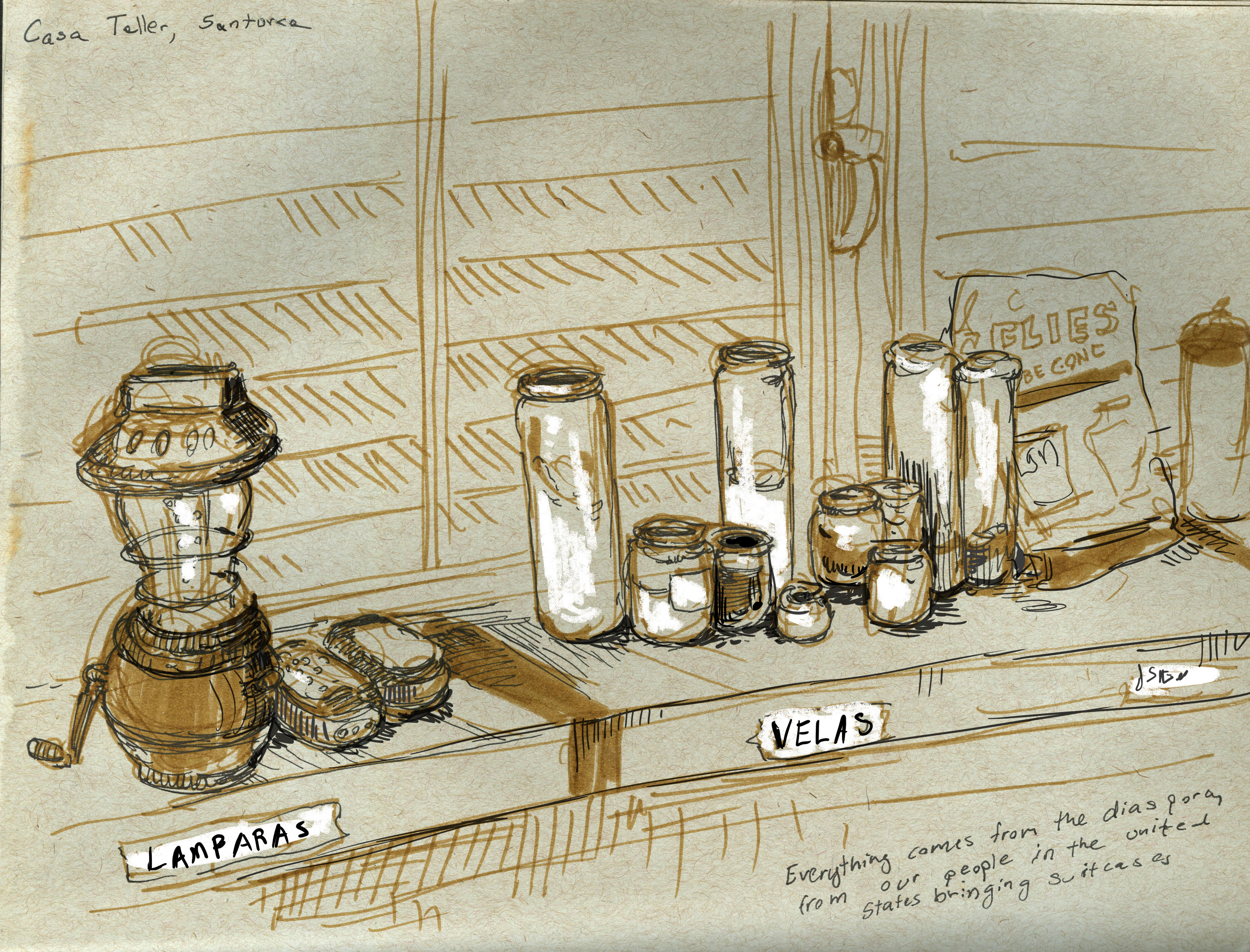 © Molly Crabapple Molly Crabapple is an artist and author of the memoir Drawing Blood. Her next book, Brothers of the Gun, cowritten with the Syrian war journalist Marwan Hisham, will be published by Random House in May 2018. Powered by WPeMatico The post Puerto Rico Sketchbook: The Radical Arts Collective appeared first on Guaripete. |
| How Do We Bury the Writing of the Dead? Posted: 11 Jan 2018 07:04 AM PST 
For over a hundred thousand years, we've buried our dead. Broadly speaking, the act has no functional purpose; according to the World Health Organization, only bodies carrying infectious diseases demand burial. Instead, it offers us, the living, a resolute end: a body in the ground. We cannot always, or even often, give literature that same assurance. If a writer leaves behind unpublished, unfinished works after their death, only the fortunate find that work disposed of according to their wishes. Carrion fowl descend upon the still-warm body, picking at even the smallest scraps of flesh. And maybe that's not a bad thing. Vultures, though not the most welcome sight, fill an important ecological role. Who are we to let them starve, even if a body wished it otherwise? Many conversations about posthumous publishing center around this question: Which is more important when considering whether to release a work, particularly an incomplete one, posthumously—authorial intent or obligation to the reader? More often than not, the latter wins the day. If we the readers had our druthers, we would have everything and more: a steady stream of singular works that possess all the qualities that first brought us to the author's door, and, once an author is gone, whatever is left of their body, mangled and lifeless though it may be. This corpse sometimes defines the author. Kafka's posthumously published works, including all three novels and countless short stories, are just as significant and refined, if not more so, than what he gave us in life; Jane Austen's catalogue feels incomplete without Northanger Abbey and Persuasion, published six months after her death; and we simply would not know of John Kennedy Toole were it not for his mother sending his textual body to Walker Percy at Loyola University. One thing is clear from these examples: words are difficult to bury. In the literal sense, anything less than the total physical destruction of a manuscript will only delay the eventual release of the work at someone else's hands. It also signals at something within us, or at least those of us who are readers or writers. We're uneasy with this destruction of words. Fulfilling the wishes of someone now gone is both one of the most natural requests we can accept and sometimes the most difficult one to provide. The eradication of Terry Pratchett's unfinished works, the zeros and ones of his hard drive ground into the earth at the Great Dorset Steam Fair, is an imaginative exception to the rule. * Even well-preserved forms—complete works whose publishing just happens to occur after a writer's death—leave us wanting. They are the opening lines of a dialogue between reader and writer cut short. Sometimes, simply knowing that a writer will no longer grace us with more words or respond to our questions and criticism is enough to shift our view of the posthumous text itself. Still, we think of this as better than nothing—better than if the work was lost forever. Through this belief, a second and more appropriate question arises: How should we view these posthumous texts, alone and in the broader context of writers' works? After all, even writers who intend their works to be posthumously published must resign themselves to end products that differ from their original conception. One can presume David Foster Wallace was at least ambivalent about The Pale King being published after his death. The work was, "not only preserved… but left… in the center of his desk." But the resulting process saw Michael Pietsch of Little Brown "diving into folders and spiral-bound notebooks," piecing together a cohesive narrative from the muddled drafts with the use of a master spreadsheet. The New York Times critic Michiko Kakutani described the resulting novel as "lumpy" and occasionally "boring," though also prone to fits of evocation (not the most unkind remark one could make about a novel detailing the life of an IRS employee). Characterizing J. R. R. Tolkien's posthumous works is a more difficult task. For one, the works he left us are numerous, in various states of completion, and many were intended to serve as scaffolding for the larger worlds he was creating. Likewise, their reception has run the gamut. His son and, until recently, estate executor, Christopher, served a prominent role in their publication. He had a larger claim than many to understanding the intent of J. R. R. himself. About The Silmarillion, Tolkien's sweeping guidebook to the history of Middle-earth, Robert Adams mused, "had [The Silmarillion] been published earlier, it might well have laid a blight on the entire series [of the tales of Middle-earth]. For The Silmarillion, despite the cuts that have evidently been made in the original materials, the selection and arrangement that have been imposed on them, remains an empty and pompous bore." Nearly all of Tolkien's works since his death, excluding the little-known children's book Mr. Bliss, has faced this uneasy critical tension. Then there is The Original of Laura, Vladimir Nabokov's focus at the time of his death in 1977. It's less a cohesive text than it is scattered fragments. Nabokov left behind, for his family to find and destroy, 138 of the index cards on which he drafted his novels. His son, Dmitri, was directed by Vladimir to destroy any of these incomplete works, just like Franz, Virgil, and Emily before him. And, just like Max, Lucius and Plotius, and Lavinia, Dmitri didn't. What distinguishes Laura from other posthumous works is the honesty of the executor and the troubling response it engendered from critics. Rather than allow the notes for Laura to be transformed into a Frankenstein's monster at the hands of an editor, Dmitri insisted Laura's viewing should take place in an honest way—that is, almost exactly as his father left the work. The published form even allows the reader to rearrange the cards as they see fit. Some were not impressed. William Skidelsky concludes his review in the Guardian by stating, "It seems likely that this book will have a more significant impact on the size of Dmitri Nabokov's bank balance than it ever will have on the world of letters." In Slate, Aleksandar Hemon argues, "The Original of Laura can't escape the musty air of an estate sale … Too sick to destroy the notecards that contain The Original of Laura, the master is now eternally exposed to a gloating, greedy world of academics, publishers, and other card-shuffling mediocrities titillated by the sight of a helpless genius." Others supported the work being published in its incomplete form, but it's not unreasonable to think that had Dmitri managed to conjure up a completed facsimile of Laura, or at least a halfway decent one, the supporters would have outweighed the critics. * Here lies our willful ignorance. Underneath it is the belief that we can—must—have the best of both worlds when giving our favorite writers a second life: the authentic, unaltered voice of the writer and a clean resulting work, no matter its state at the time of their death. In other words, an impossible paradox. In judging posthumous work, readers rarely consider the state of the work at the time of the author's death, its objective quality to begin with, or the intentions of the writer. The only thing we recognize is whether the end result is a text that fits the writer's existing body of work. An alternative exists that isn't terribly radical. We could simply not publish these works. Leave the drafts in a set of filing cabinets at a liberal arts university where, most likely, even the most modestly successful writer will find academic patrons to carry on their memory. Or, we could allow the creation of statuesque remembrances, without attributing them as the authentic voice of the deceased author. Bring in one of the most prominent writers of the time, or a group of them, to finish and edit the text by committee. As long as we separate the result from the body of work created by the writer in their lifetime. After all, we don't mistake the statues in public squares for an exact replica of the person who once lived. We could even allow both to exist, but rest apart. Perhaps in concert, the two will breed an honesty in expectations and criticism of the work. But don't soak the unfinished manuscripts in paraffin, dress them in their Sunday best, and parade them around town as if the synapses were still firing. The well-worn Faulkner line "the past isn't dead. It isn't even past" is as true for literature as it is for history. But sometimes, it's still worth acknowledging the smell of death. Adin Dobkin is a writer and journalist in Washington, D.C. Powered by WPeMatico The post How Do We Bury the Writing of the Dead? appeared first on Guaripete. |
 A great Rec League subject for the upcoming 2018 Olympics, we want to say thanks to Reader Eve for emailing us this request:
 Yeah, that's right – Netflix, cheese, and "Wonderwall." If that's not a winning combination, I don't know what is. Regardless, I hope you all enjoy this selection of links and…I'm sorry, but there's more Star Wars stuff.




| You are subscribed to email updates from Books Trending News. To stop receiving these emails, you may unsubscribe now. | Email delivery powered by Google |
| Google, 1600 Amphitheatre Parkway, Mountain View, CA 94043, United States | |

No comments:
Post a Comment