Books Trending News – Guaripete | Online Store |
- Historical Romances, Including a Boxed Set
- Bitcoin Mania
- An Inspired Theft
- Tom Sachs and David Searcy: Japanese Tea, Rockets, and Switchblades
- Staging Octavia Butler in Abu Dhabi
| Historical Romances, Including a Boxed Set Posted: 09 Jan 2018 07:05 AM PST 
Don’t want to miss an ebook sale? Sign up for our newsletter, and you’ll get the week’s available deals each Friday. Powered by WPeMatico The post Historical Romances, Including a Boxed Set appeared first on Guaripete. |
| Posted: 09 Jan 2018 07:04 AM PST  Blockchain Revolution: How the Technology Behind Bitcoin Is Changing Money, Business, and the World by Don Tapscott and Alex Tapscott Portfolio/Penguin, 348 pp., $30.00 Attack of the Fifty Foot Blockchain: Bitcoin, Blockchain, Ethereum and Smart Contracts by David Gerard CreateSpace, 178 pp., $16.95 (paper)  James MacWhyte at a bitcoin trading club meeting, Tokyo, February 2014 The first time I bought virtual money, in October 2017, bitcoins, the cryptocurrency everyone by now has heard of, were trading at $5,919.20. A month later, as I started writing this, a single coin sold for $2,000 more. "Coin" is a metaphor. A cryptocurrency such as bitcoin is purely digital: it is a piece of code—a string of numbers and letters—that uses encryption techniques and a decentralized computer network to process transactions and generate new units. Its value derives entirely from people's perception of what it is worth. The same might be said of paper money, now divorced from gold and silver, or of gold and silver for that matter. Money is a human invention. It has value because we say it does. In 2008, when a person or persons going by the name Satoshi Nakamoto published the whitepaper "Bitcoin: A Peer-to-Peer Electronic Cash System," bitcoins were worth nothing because they didn't exist. Three months later, when the first version of bitcoin software was released by Nakamoto and the inaugural bitcoins were traded, they were essentially free. By September 2010, a single bitcoin cost about six cents. By June 2011, it was $22.59. And while the price had its ups and downs, the overall trend was up, up, up. By the end of 2013, as the idea of a currency controlled exclusively by computers running cryptographic algorithms created and traded without the intercession of a central bank, a nation-state, a taxation authority, or any kind of regulation began to take hold, especially among libertarians and those unsettled by the financial crisis, as well as among black-market criminals and terrorists, it was nearly $1,000.* The higher the price, the greater the interest of investors and speculators, which propelled the price even higher. Because the software was programmed to issue a finite number of bitcoins—21 million—bitcoin's spectacular trajectory seemed, and continues to seem, like a textbook case of supply and demand. (Nearly 80 percent have been issued so far through a computer-intensive process called "mining.") How high will the price go? The Internet is full of prognostications—$22,000 by the end of 2018, $50,000 by 2020—that make bitcoin's mid-December valuation at over $18,000 look like a bargain, which, of course, is driving more investment. And this despite warnings of a bitcoin bubble, predictions of a future crash, and an admonishment from Jamie Dimon, the CEO of JPMorgan Chase, who called bitcoin a fraud that will not end well for investors. Still, Dimon conceded that for people who reside in countries with unstable currencies and hyperinflation, like Venezuela or Argentina, bitcoin might be a useful option, as indeed it has turned out to be. He also acknowledged its utility for the two billion people around the world without access to traditional banking institutions, who are known as "the unbanked." For them, a cell phone can function as a bankbook, a debit card, and a way to send and receive payments. A website called Abra, for example, enables users to send bitcoins, which are denominated fractionally down to eight decimal points, from one mobile phone to another, anywhere in the world; the receiver can keep the payment in bitcoin or exchange it for digital dollars or pesos or some other currency, and spend them at merchants that accept Abra as a payment system. It gets a little more complicated, though, if the recipient wants to convert the payment into physical cash. Consider the case of an unbanked Filipino woman who has received a remittance from her daughter in Canada. As Don and Alex Tapscott explain in Blockchain Revolution: How the Technology Behind Bitcoin Is Changing Money, Business, and the World: "She checks the app and notices there are four other Abra users within a four-block radius of her. She messages them all to see who will exchange her digital pesos for physical pesos and at what price. The four come back to her with different 'bids.'" She then chooses the one with the highest customer satisfaction rating, though not the lowest bid, and meets him to make the exchange. Using bitcoin as if it were "regular" money to buy things, however, has proved to be more challenging, in part because its value keeps fluctuating, and in part because businesses have been slow to accept it as a form of payment. That may be changing. You can now use bitcoin to pay for a pizza from Domino's or a sandwich from Subway, a subscription to the Chicago Sun- Times or the Dish Network, a couch (and anything else on its site) from Overstock, a gallon of maple syrup from a small sugarhouse in Vermont, or airline tickets on a number of carriers—and the list is growing. My own cryptocurrency exchange experience was more mundane than that of the woman in the Philippines. I logged onto a website called Coinbase and created an account linked to my credit card. Coinbase gave me the option of buying three different digital currencies: bitcoin, ether, or litecoin. Since the $50 I was willing to invest was more than ten times less than the cost of a single bitcoin even before Coinbase subtracted its service fee, I figured the fractional amount of bitcoin I'd be buying—something on the order of .0076—would hardly be worth it. (Full disclosure: I was wrong.) So instead of bitcoin, I bought .16 ether, and in November 2017, my $50 was up to about $54. But if I cashed out then, Coinbase's fees to do so would have lowered the amount close to my original stake. These days, transaction fees on cryptocurrency in general, and bitcoin specifically, can be fairly steep. The irony here is that digital currency has been championed as offering more value than traditional money because it moves directly from person to person without the interference of extractive intermediaries like banks and other financial institutions. In theory, that is how peer-to-peer networks are supposed to work. But as more and more money has poured into digital currencies, those banks and financial institutions have begun to move in. Coinbase, for example, which now has more accounts than the legacy brokerage Charles Schwab, began as a Silicon Valley start-up aimed at making the process of buying and selling cryptocurrencies as easy as online banking. It has received investments from major venture capital funds—Andreessen Horowitz, Union Square Ventures, and DFJ, among others—as well as from the New York Stock Exchange and a number of traditional banks. Those investments have further driven the ever-increasing value of cryptocurrencies. So has—thus far—the ancillary market in bitcoin futures, which opened for trading in mid-December 2017. While this is arguably how markets are supposed to work, the booming trade in bitcoin has made things difficult for the bitcoin operating system, which is having trouble processing the high volume of transactions coming its way. What began as a structural feature of bitcoin software—that only one-megabyte blocks of transaction data (currently 2,200 to 2,500 transactions on average) could be processed every ten minutes—has become a structural obstacle, as transactions get bottlenecked and the speed at which new ones can be resolved slows to a crawl. One day this past December, for instance, traffic in bitcoin was so overwhelming that many Coinbase account holders were unable to log into their accounts. Even when it is working smoothly, the bitcoin network is only able to process seven transactions per second. By contrast, PayPal processes 193, and Visa 1,667. If there is any chance of bitcoin becoming a commercially viable method of payment, it will have to scale up. But scaling up will require a structural change, and since bitcoin software is an open source project with no central authority, amendments to it are ceded to the voluntary developer community. So far, numerous solutions to the scalability issue have been debated, but no consensus has emerged. The central obstacle to a fully automated monetary system run exclusively by computers is validation: how to ensure that the transactions on the network are legitimate. The bitcoin software devised by Nakamoto employs a number of features to deal with this. The first is basic encryption. A bitcoin is nothing more than a record of value—you have seven bitcoin, I have five bitcoin, and so on—encoded and stored on the bitcoin system as an address. To release that bitcoin to buy something or to cash it out, its owner must use a private encryption key, known only to him or her, which is associated with that account. Matching the private key with the address is done automatically by the decentralized network of computers. If they don't match up, or if the owner of the private key is attempting to spend his or her bitcoin more than once, the computers reject the transaction. The "miners" who verify and collect these transactions into a block—"miners" being a term for those who run the computers on the network—are also required by the bitcoin software to perform an additional validating function before the block can be added to the bitcoin ledger. Called "proof of work," it is essentially a computational lottery in which all the mining computers vie to guess an algorithmically generated number between zero and 4,294,967,296 with the correct number of zeros preceding it. Finding the target number takes trillions of guesses and a tremendous amount of computing power. The idea behind "proof of work," according to Daniel Krawisz, of the Satoshi Nakamoto Institute, is that it is "an added complication, like a ritual, so as to make blocks more difficult to generate…. [It] is…a means for a group of self-interested people, none of whom is subordinate to any other, to establish a consensus against a considerable incentive to resist it." Because it takes so much computing power to find this number, miners are motivated to ensure that the transactions they are processing are valid and nonconflicting. But they are motivated to participate in the first place because the software generates a reward: the miner who finds the "proof of work" number first is paid in (an algorithmically determined number of) bitcoins. Though that is how new bitcoins are created, or "mined," and added to the system, as the Tapscotts point out, mining is
When the bitcoin network began operating in 2009, people could run the validation program on their personal computers and earn bitcoins if their computer solved the puzzle first. As demand for bitcoin increased, and more people were vying to find the random, algorithmic proof of work validation number, speed became essential. Mining began to require sophisticated graphics cards and, when those proved too slow, special, superfast computers built specifically to validate transactions and mine bitcoins. Individual miners have dropped out for the most part, and industrial operators have moved in. These days, mining is so computer-intensive that it takes place in huge processing centers in countries with low energy costs, like China and Iceland. One of these, in the town of Ordos, in Inner Mongolia, has a staff of fifty who oversee 25,000 computers in eight buildings that run day and night. A company called BitFury, which operates mining facilities in Iceland and the Republic of Georgia and also manufactures and sells specialized, industrial processing rigs, is estimated to have mined at least half a million bitcoins so far. At today's price, that's worth around $7.5 billion. Still, it's not exactly free money. Marco Streng, the cofounder of Genesis Mining, estimates that it costs his company around $400 in electricity alone to mine each bitcoin. That's because bitcoin mining is not only computationally intensive, it is energy-intensive. By one estimate, the power consumption of bitcoin mining now exceeds that of Ireland and is growing so exponentially that it will surpass that of the entire United States by July 2019. A year ago, the CEO of BitFury, Valery Vavilov, reckoned that energy accounted for between 90 and 95 percent of his company's bitcoin-mining costs. According to David Gerard—whose new book, Attack of the Fifty Foot Blockchain, is a sober riposte to all the upbeat forecasts about cryptocurrency like the Tapscotts'—"By the end of 2016," a single mining facility in China was using "over half the estimated power used by all of Google's data centres worldwide at the time." One way bitcoin miners offset these costs is by collecting the very thing digital money, traded peer-to-peer, was supposed to make obsolete: transaction fees. By one estimate, these fees have risen 1,289 percent since March 2015. On any given day, the fees will be in the millions of dollars and now cost upward of twenty dollars per transaction. While transaction fees are not mandatory, they are a way for users to attempt to jump the queue in a system rife with bottlenecks, since those who offer miners a fee to have their transactions included in a block have a better chance of that happening. With so many transactions lined up, waiting to be processed, miners have discretion over which will make it to the head of the line; the higher the fee, the more likely it is to be chosen. As the explanatory website Unlock Blockchain puts it: "when miners mine a block, they become temporary dictators of that block. If you want your transactions to go through, you will have to pay a toll to the miner in charge…. The higher the transaction fees, the faster the miners will put [the transactions] up in their block." As a consequence, transactions can be held up for hours or days or dropped altogether. Bitcoin's high transaction fees and slow transaction times were two of the reasons I chose to buy ether. But there was another reason as well: while bitcoin was invented to bypass traditional currency by tendering a new kind of money, ether, another cryptocurrency that can be bought, sold, and used to purchase goods and services, was created to raise capital to fund a project called the Ethereum network. The principals behind it are building out what is being trumpeted as the next iteration of the Internet, Web 3.0, also known as "the blockchain."  A blockchain is, essentially, a way of moving information between parties over the Internet and storing that information and its transaction history on a disparate network of computers. Bitcoin, for example, operates on a blockchain: as transactions are aggregated into blocks, each block is assigned a unique cryptographic signature called a "hash." Once the validating cryptographic puzzle for the latest block has been solved by a mining computer, three things happen: the result is timestamped, the new block is linked irrevocably to the blocks before and after it by its unique hash, and the block and its hash are posted to all the other computers that were attempting to solve the puzzle. This decentralized network of computers is the repository of the immutable ledger of bitcoin transactions. As the Tapscotts observe, "If you wanted to steal a bitcoin, you'd have to rewrite the coin's entire history on the blockchain in broad daylight." While bitcoin operates on a blockchain, it is not the blockchain. The insight of Vitalik Buterin, the young polymath who created Ethereum, was that in addition to exchanging digital money, the blockchain could be used to facilitate transactions of other kinds of digitized data, such as property registrations, birth certificates, medical records, and bills of lading. Because the blockchain is decentralized and its ledger immutable, those transactions would be protected from hacking; and because the blockchain is a peer-to-peer system that lets people and businesses interact directly with each other, it is inherently more efficient and also cheaper than systems that are burdened with middlemen such as lawyers and regulators. A company that aims to reduce drug counterfeiting is using the blockchain to follow pharmaceuticals from provenance to purchase. Another outfit is doing something similar with high-end sneakers. Yet another start-up, this one called Paragon, is currently raising money to create a blockchain that "registers everything that has happened to a cannabis product, from seed to sale, letting consumers, retailers and the government know where everything came from." "We are treating cannabis as a normal crop," Paragon's founder and CEO Jessica VerSteeg, a former Miss Iowa, told a reporter for the website Benzinga. "So, the same way that you would want to know where the corn on your table came from, or the apple that you had at lunch came from, you want to know where the weed you're consuming came from." While a blockchain is not a full-on solution to fraud or hacking, its decentralized infrastructure ensures that there are no "honeypots" of data available for criminals to exploit. Still, touting a bitcoin-derived technology as the answer to cybercrime may seem a stretch in light of the high-profile—and lucrative—thefts of cryptocurrency over the past few years. Gerard notes that "as of March 2015, a full third of all Bitcoin exchanges"—where people stored their bitcoin—"up to then had been hacked, and nearly half had closed." There was, most famously, the 2014 pilferage of Mt. Gox, a Japanese-based digital coin exchange, in which 850,000 bitcoins worth $460,000,000 disappeared. Two years later another exchange, Bitfinex, was hacked and around $60 million in bitcoin was taken; the company's solution was to spread the loss to all its customers, including those whose accounts had not been drained. Then there was the theft via malware of $40 million by a man in Pennsylvania earlier this year. He confessed, but the other thieves slipped away, leaving victims with no way to retrieve their funds. Unlike money kept in a bank, cryptocurrencies are uninsured and unregulated. That is one of the consequences of a monetary system that exists—intentionally—beyond government control or oversight. It may be small consolation to those who were affected by these thefts that neither the bitcoin network nor the Ethereum network itself has been breached, which perhaps proves the immunity of the blockchain to hacking. (In 2016, there was a $60 million hack of a company running on the Ethereum system, but the theft occurred because there was a bug in that company's software.) In addition to demonstrating that a blockchain could be used to build out new ventures, Buterin also showed that those new ventures could be financed, like the Ethereum Network, by the crowd-funded sale of their own branded cryptocurrency. So, for example, Paragon created its own digital "coin," ParagonCoin, and put 100,000,000 up for sale at $1 per coin (to be paid in cryptocurrency). ParagonCoins can be traded for services, once the business is operational—whenever that is—or traded for crypto- and other currencies. In addition to Jessica VerSteeg, Paragon is fronted by Jayceon Taylor, who is better known in some circles as the rapper The Game. Celebrity promoters like Taylor have become routine in this world of ICOs—initial coin offerings. The boxer Floyd Mayweather is the face of Stox, an ICO that raised $30 million for a service that is supposed to predict sports scores, stock prices, and even the weather. (It appears unable to predict when Stox itself might be up and running.) Another rapper, Ghostface Killah, of the Wu-Tang Clan, is the chief branding officer for Cream Capital, a company that is looking for $30 million to become the world's largest distributor of cryptocurrency ATMs. Cream Capital got its name from Wu-Tang's 1993 hit "C.R.E.A.M.," which stands for "cash rules everything around me." It's now been repurposed to mean "crypto rules everything around me." For the moment—and until either the Securities and Exchange Commission decides that ICOs are illegal or investors become wary of tossing money at projects that do not exist and may never exist—crypto, in the form of ICOs, does seem to rule start-up funding; as of this past summer more money has been raised from these crowd-sourced coin offerings than from established venture capital funds and angel investors. Writing in The New York Times, Nathaniel Popper tells of a group of coders in the Bay Area who raised $35 million in under thirty seconds for a proposal to create an ad-free Web browser, and a Swiss team that received $100 million to develop an online chat program. According to the website CoinDesk, as of this fall, more than $3.5 billion has been invested in ICOs, almost all of it in 2017, with close to $3 billion pouring in between June and the end of October. "It's kind of like when you are a little kid and you know you are getting away with something," an investment analyst named Chris Burniske told Popper. "It's not going to last forever, but it's fun in the interim. The space is giddy right now." Vitalik Buterin's other innovation was to show how smart contracts could be written and stored on the blockchain. These are covenants, written in code, that specify the terms of an agreement. They are "smart" because as soon as its terms are met, the contract executes automatically, without human intervention. Once triggered, it can't be amended, tampered with, or impeded. A writer for the Foundation for Economic Education calls this "programmable money":
Where it might go is anyone's guess, but there is no doubt that smart contracts and the blockchain itself augment the trend toward automation, though it is automation through lines of code, not robotics. For businesses looking to cut costs, this is one of the main attractions of blockchain technology. "If contracts are automated, then what will happen to traditional firm structures, processes, and intermediaries like lawyers and accountants?" ask Marco Iansiti and Karim Lakhani in the Harvard Business Review. "And what about managers? Their roles would all radically change." Indeed. Most blockchain advocates imagine them changing so radically as to disappear altogether, taking with them many of the costs currently associated with doing business. According to a report from the research arm of the Spanish bank Santander, the blockchain "could reduce banks' infrastructure costs attributable to cross-border payments, securities trading, and regulatory compliance by $15–20 billion per annum by 2022." "Whereas most technologies tend to automate workers on the periphery doing menial tasks," the Tapscotts quote Buterin saying, "blockchain automates away the center. Instead of putting the taxi driver out of a job, blockchain puts Uber out of a job and lets the taxi drivers work with the customer directly." Forget for a moment that this sounds a lot like standing on a street corner and hailing a livery cab: what Buterin is talking about is actually something potentially revolutionary, as the Tapscotts suggest in their title. Whether it will be a revolution for good or one that continues what has come to seem technology's inexorable, crushing ascendance will be determined not only by where it is deployed, but how. The CIA (through its venture capital group, In-Q-Tel), the defense contractor Northrop Grumman, NASDAQ, Deloitte, Toyota, UnitedHealth, Fidelity, IBM, Credit Suisse, Goldman Sachs, Microsoft, and even JPMorgan Chase, to name just a few, are all looking to employ blockchain technology. So are UNICEF, the Indian state of Andhra Pradesh, and the charity Mercy Corps. The Tapscotts imagine that the blockchain could be used by NGOs to eliminate corruption in the distribution of foreign aid by enabling funds to move directly from giver to receiver. But they also envision it as a way for banks to operate without external oversight, encouraging other kinds of corruption. Either way, we'd be wise to remember that technology is never neutral. It is always endowed with the values of its creators. In the case of the blockchain and cryptocurrency, those values are libertarian and mechanistic; trust resides in algorithmic rules, while the rules of the state and other regulatory bodies are viewed with suspicion and hostility. Both the Ethereum and bitcoin blockchains are public: anyone can see their ledgers of transactions. For this reason, they are called "permissionless." The ledger doesn't reveal who purchased what by name, but does show what was purchased and when it was purchased and by which encrypted pseudonym. While this is a security feature of a permissionless blockchain, it has also proved to be a boon to law enforcement. The FBI was able to catch Ross Ulbricht, the mastermind of Silk Road—the multimillion-dollar criminal enterprise he operated on the dark web through which users could exchange drugs and guns and stolen goods for bitcoin—because after seizing his computer, they were able to link him to the bitcoin wallets where he stored his earnings. They then used the ledger to trace his entire transaction history. Ulbricht is now serving a sentence of life without possibility of parole, and the criminals and terrorists who, before his arrest, had relied on bitcoin to shield their identities are using tumblers—programs that mix transactions and make them hard to link to a specific account—or they have migrated to cryptocurrencies that promise full anonymity, which neither the bitcoin nor Ethereum network does. Just as criminals want to shield their identities on the blockchain, corporations and other institutions are wary of putting proprietary information on a permissionless network. Instead, companies have been exploring how to adapt the blockchain for business, creating invitation-only, "permissioned" peer-to-peer networks that enable speed and efficiency (often by eliminating jobs and bypassing regulation), security, and immutability, while discarding the public and energy-intensive aspects of the original version of blockchain technology. Last May, the R3 consortium—an association of major banks and financial services companies including ING, Barclays, UBS, Wells Fargo, and the Bank of Canada, as well as the government of Singapore—announced that it had raised $107 million to develop commercial (gated) blockchain applications. And Goldman Sachs has patented its own cryptocurrency, SETLcoin, to digitize and trade real-world assets such as property deeds and stocks on a blockchain. According to Goldman's patent application, these assets will be verified by a trusted third party, such as the Securities and Exchange Commission. There is no better illustration of the propagation and acceptance—which is to say, co-optation and perversion—of Satoshi Nakamoto's idea of a peer-to-peer, decentralized blockchain trading network, born out of the 2008 financial crisis and an inherent distrust of banks and governments, than a cryptocurrency patent held by an investment bank that relies on an official, third-party regulatory agency for authentication. Meanwhile, at press time, my $50 of ether was up to $130, and Nakamoto's creation was trading at over $15,000. It took nearly five years for the value of a bitcoin to rise from $0 to $1,000; it had taken five hours for it to move from $15,000 to $16,000. This is not typically how money appreciates. Yet bitcoin is anything but typical. It is computer code in which people have invested the idea of value. When that idea, which by now has morphed into the belief that it's possible to get filthy rich out of thin air, no longer captures the public imagination—if the bubble bursts—the blockchain will persist. As those who actually control the flow of money—the banks and corporations and governments—know, that is where the real value of Nakamoto's invention lies. —December 21, 2017 Powered by WPeMatico The post Bitcoin Mania appeared first on Guaripete. |
| Posted: 09 Jan 2018 07:04 AM PST  Good artists imitate; great artists steal. In our series Stolen, writers share stories of theft.
Long, long ago, in the faraway kingdom of Virginia, a tall, somewhat-handsome man came to town. He had a rather well-known art gallery for a time in New York City, though in those days the word gallerist had not yet been invented, so he was just thought of by name. This man had come with his daughter, an equestrian, to visit several artists who showed at his gallery. This was a time so distant that Banksy, while certainly more than a gleam in his father's eye, was not yet a star. One afternoon, the gallerist, accompanied by his little daughter, went to a stable and climbed on a horse, and off they clomped, merrily. But what should happen then but that the horse, named "Terror" if I remember correctly and "Terrible" if I do not, somehow shook the man from its back, causing him to break his leg in two places. One of the painters—who had toiled all day, concentrating and considering, though this was before political correctness, so no left-brain/right-brain introspective frenzy added to the painter's exhaustion … anyway, this painter got in his car and drove to the stables at the appointed hour, asked for the man and the little daughter, only to be told that no such man had ridden that day. Confused, the painter gave an excellent visual description of the man, after which the stable man did, indeed, remember: the tall fellow who'd been taken to the hospital. To the hospital! Somehow the man had been X-rayed, put in a cast, and sent limping off on crutches, the little daughter at his side, so that by the time the painter arrived, the man was already at the home of his cousin (let's call her L) in the county. L lived in a house sequestered even from other houses where—it had been decreed earlier—all the busy, talented painters were to spend the evening discussing important art matters, telling bleak jokes, and needling their gallerist (his seriousness in all matters did, indeed, make him a figure of fun). All the poor man could do was sit with one leg in a cast stretched in front of him, atop a footstool with an added pillow, looking grim, because being thrown from a horse and injured will almost always ruin one's mood. In any case, the phrase no problem had not yet been invented then. Now, this may seem as unbelievable as having no olive oil in the house, no Merrells on one's feet, no microbrew to swill with the tacos. Yes, it was a very long time ago. It might even have been that there was no moon. On this long-ago evening at the remote house of L—poor, long-suffering L, who surely did not look forward to artists guzzling her wine—who happened to come along but one of the painter's wives. Yes, me! The other wives must have been too clever. As I think back, perhaps this one was not yet a wife, though that would hardly matter, except that it might have gotten her out of being there, in the dark, with the suffering L, the pained gallerist, and his little daughter, who thought it was so ridiculous her father had fallen off a horse. Here's the end of the story. This is true: I went to L's bathroom, perhaps to pee, perhaps to escape the conversation, and I saw a Post-it note above the toilet-paper dispenser. Now, this might have been in the distant past, but still, it was not so long ago that there were no Post-it notes. But above the toilet-paper dispenser? It had two words on the top line. It said, "I AM," and then below that, allocated one line each, the words: HUMBLE I took it immediately. I tucked it in my sports bra. It hung, forever after, on the circular mirror above my sink (tape had to be added when it lost its stickiness.) For all I know, it hangs there still, to tell someone else she's the fairest of them all. This all happened in the lovely renovated house in which I lived after my NYC landlord raised my rent one time too many. And for years and years—even then, years were years—my two friends P and T came weekly (right: feel your privilege, Beattie, you jerk) to clean my house. They made no comment about the note stuck in the middle of the mirror. It was only when I said something offhandedly that I realized they had much discussed it between themselves. They were relieved to hear my story because it was so unlike me that, well, a mystery had been solved—for these were times when some mysteries were still solved; not many, but some—even sans Sherlock Holmes. Oh, that day we three laughed so merrily! We could not have been more amused if the dish had run away with the spoon, or if a cow had jumped over the pale full moon. Back in that long-ago day, even the moon might have been only a misperception about the bathroom mirror. Ann Beattie's short story "Ruckersville" appeared in our Fall issue. She is the author, most recently, of The Accomplished Guest. Read her Art of Fiction interview. Powered by WPeMatico The post An Inspired Theft appeared first on Guaripete. |
| Tom Sachs and David Searcy: Japanese Tea, Rockets, and Switchblades Posted: 09 Jan 2018 07:04 AM PST   "Tom Sachs: Tea Ceremony" Tom Sachs: Tea Ceremony at the Nasher Sculpture Center in Dallas (which closed yesterday) was a vast and complex exhibition of ideas within ideas about ideas, wherein the protocols of the Japanese tea ceremony and those of NASA's space program are revealed to express opposed yet deeply similar understandings and even longings. There is a "me upon my pony on my boat" sort of yearning throughout this profound yet willfully childlike theater of imitation. Lucia Simek, an artist and the communications manager for the museum, and a friend of both Sachs and the writer David Searcy, arranged for the two to get together in the spirit of their weirdly similar interests—rockets, Mars, Japanese tea bowls, and switchblade knives. Part 1  Tom Sachs (left) and David Searcy (right) standing by Sachs's Big Cock, a reconstruction, in red-painted 1/4 inch plywood puzzle pieces, of Brancusi's famous abstract rooster. SEARCY I had great doubts after just seeing shots of this piece in the press. It looked like easy ironies. I didn't realize this was after the Brancusi, I thought this was Jean Arp or something. But immediately, when I saw it in person, I came upon this thing that's just adoration. I thought to myself, This is a guy who does crossword puzzles with a ballpoint pen. SACHS (Laughs.) Thank you. I really appreciate that. My drawing teacher was Guy Goodwin. He taught at Cooper Union, and at Bennington, where I went. He's a legend at helping each person find their way into drawing. And for me, he was just, Draw it! And sometimes he'd like smack me, not in the face but like in the back (Tom smacks himself in the back of the head) just to kind of shock me, and to say, Just go! SEARCY Well, he sounds like a Zen master with the whack on the head, you know. SACHS Yeah, yeah—and so I went to Brancusi's atelier in Paris, measured it, built a form that was a quarter of an inch less than this and then just went. I'm not skilled, but I just threw a lot of tenacity and care into it. SEARCY How many pieces wound up on the floor? SACHS A big pile—but those scraps are sacred. I'm very careful to make sure people don't sweep up the scraps. Because, you know, you've got the negative of it on the floor. So that's a good place to start with the next idea. SEARCY Wandering around, looking at everything in this show—there are pieces deriving from NASA's space program, tea ceremony, iconic modern art—you almost always go for the artifact, the preexisting idea. You reproduce the idea. And it's about the idea. It's an idea about ideas. And I don't see the natural world appearing here at all except when you look at the ground. That's the world. That's the dirt. That's the rock. Is that your default? 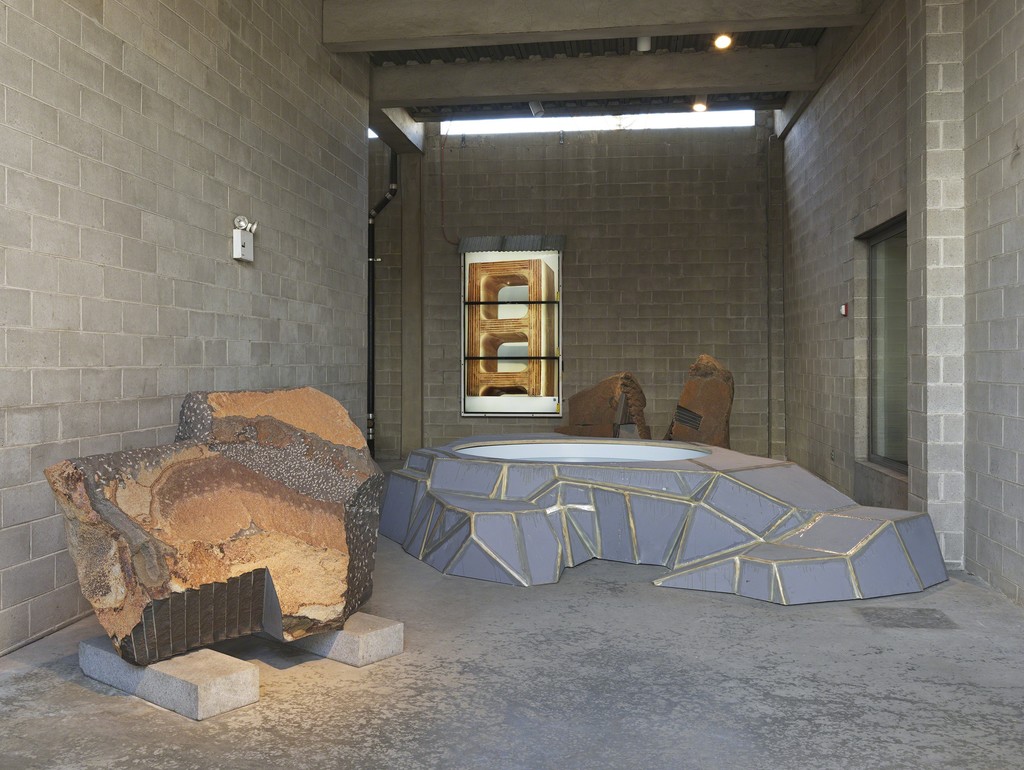 Tom Sachs, Pond Berm, 2017. Installation view at the Noguchi Museum. SACHS The ground? SEARCY The ground like in there (indicating the next room, the Outer Tea Garden, where a faceted, gray, stonelike "berm" surrounds a koi pond). SACHS Oh, the berms. Yeah. SEARCY That's a natural object. It's not an idea of the world. It's the world. SACHS Right. I think I've started with the things I love—like McMop Buckets (referring to his foam core reconstruction of a McDonald's mop bucket with ringer) and modernist sculpture and spaceships. But then to go do nature is tough because nature is so refined—it's so sophisticated and complicated and simple. But you know, if you look at that Noguchi over there (a large stone sculpture by Isamu Noguchi on loan from the Noguchi Museum to join Sachs's Tea Garden)—that's a found rock, he did just a very few interventions. SEARCY The scholar's rock tradition, almost. SACHS I think probably ninety percent of it was just selecting the right rock and putting it at the right angle, and everything else was about ten percent. So, yeah, I think the way I'm doing those berms is trying to keep it to the minimum number of gestures to still look like nature and yet not be too shitty. SEARCY What it reminds me of is a certain kind of camera they use in astronomy—they're all terrifically sensitive, and if you're looking at a planetary object or a nebula, then that's what you get, but if it goes to black sky it starts picking up its own static. You tune the gain way up to a place on an empty field and this is what comes out. SACHS So you just see—what do they call it?—the artifact. SEARCY Yeah. It's like you're just looking at the world itself without idea imposed upon it. You get this wonderful—as my wife who is an art historian knows—Giotto-like late medieval ground. And there's this sense, speaking of Japanese tradition, that the idea is not really understood until it's imitated. There's this sixteenth-century Korean rice bowl that's a Japanese national treasure. The story goes, the student of tea asks the museum curator, How can the Koreans know how to make such a wonderful tea bowl? And the reply is, Well they can't know. If they knew what they were doing, they couldn't make a beautiful tea bowl. SACHS So it's just by virtue of the Japanese regard. SEARCY Right, the regard creates the idea. And, I mean, your regard almost remakes the idea. SACHS I'm trying to understand what you're saying. I'm very selective about the things that I choose to represent and make. But I never really thought about how that's quintessentially Japanese—like stealing Korean rice bowls to make them into these kind of things. SEARCY It's not a national treasure until you know it to be. SACHS Right. And that's the job of the artist or the curator or the scholar or … I don't know how that happens. SEARCY I don't know either. I don't know either. (Laughter.) SACHS But I know that in the things we choose to represent, there are some things that work out better than others. And Marcel Duchamp, he's the guy who takes the urinal and puts it on the pedestal and says, Okay, now this is art. And that's regard. SEARCY Sure. Yeah, exactly. SACHS And then I don't know if you are aware of this word mitate? It's a Japanese word that means using the wrong thing for the right reason—or appropriation. I think that guy Rikyu, Sen no Rikyu, the sixteenth-century father of the way of tea, was the first guy to do some of what Duchamp was doing, with that Korean rice bowl. SEARCY Well, it starts in the sixteenth century with tea, and then there's the Renaissance. The moments of self-consciousness. Modern art is an exquisite perfection, or concentration, I should say, of self-consciousness. And that's why it's so easy to think, well, it's about irony. But irony is nothing. Irony is not even a gate. Irony is a vast illusion. You think you're getting leverage with irony—you're not. You're just posing. The self-consciousness that occurred with that wabi thing—the sense of beauty that celebrates the struggle, the simple and imperfect gesture in the making of a thing. What's more impossible than to contrive to be absolutely honest and natural? It's almost the beginning of modern art, in a sense, in that moment—that tremendous self-consciousness. SACHS Well, I think that's a really important time. I think that's one of the reasons why I'm so interested in the tea ceremony. And also, by the way, every samurai movie you've ever seen takes place in that same period. Like, we don't really know anything else about Japan before or after.  Still from A Space Program SEARCY I just saw A Space Program. SACHS Yeah. SEARCY And even if there had there been no tea ceremony in the middle of it, it would nonetheless have spoken very clearly to what happened in here (indicating the adjoining Tea Garden and Tea House)—I mean, to me, in the middle of this utsushi, there's this caution. The red-and-white-striped barricades. That's important—the idea is startling. Be careful! Ideas are startling! SACHS Oh that's (laughs)—I never really put it together. SEARCY I just think it's terrifically important. I was standing there watching my wife participating in the tea ceremony for about an hour and a half, and all this calm is surrounded by this signal—Be careful! Look out! Go away! Don't come any … Oh God, an idea! This is terrifying stuff!  Tom Sachs, Tea Ceremony, 2017. SACHS I'd never thought about that. SEARCY Peacefulness is terrifying. SACHS It is. SEARCY And the outer space and the inner space. SACHS Don't they do a thing—aren't there some tests where they put you in an orange room and you go a little crazy, so they put you in blue and green rooms? I remember when I was a kid, we lived in an old house and my mom was redoing my bedroom and said to me, You're old enough to pick the color. I was into the New York Mets, so I said, I want the walls orange and the furniture blue like the Mets. But I didn't realize I was buying into an orange room, and I must have lived in that room for a decade—in this orange room, right? And I think maybe that's one of the reasons why I'm so fucked up (laughs). SEARCY My excuse is I fell out of a tree. Yours is much more interesting. SACHS You fell out of a tree? SEARCY Yeah, out of a tree. SACHS Did you hit your head? SEARCY Yeah, yeah. SACHS Awesome. It so worked in our case. SEARCY Do you have time to come over? SACHS Yeah. SEARCY That would be great. I, too, have rockets (in silly Russian accent). I, too, have tea bowls. SACHS Amazing. Part 2 Across town at David Searcy's place, standing before a floor-to-ceiling glass case of Japanese tea ware, seventeenth century to modern, several repaired by the traditional Japanese gold-lacquer process called kintsuge, which Tom Sachs also employs with certain of his NASA tea bowls.  Sachs, Searcy, and Presto. SEARCY I love your kintsuge. Here is a very elaborate kintsuge on a very undistinguished bowl—it became the fashion in the nineteenth century to recover these old tea bowls as "wasters" from kiln sites and restore them as if they were precious. And the regard for them makes them precious. SACHS Yes. SEARCY Like we were talking about. SACHS I'm making the same tea bowl over and over again. The bowl that I'm making now is for Johnny Fogg. He comes over, and it's too thick, too thin, too heavy, too light, too big, too small—we're making this Goldilocks bowl. I've made six hundred of them, but we're always trying to refine and I'm getting closer and closer—like the Fibonacci sequence, always getting half… SEARCY Or Zeno's Paradox. SACHS Is that what it is? Is that what it's called? SEARCY Yeah, you can only get half. (Drifting out onto the back deck toward a little observatory, entering the observatory through a tiny door.)  Tom Sachs (left) and David Searcy, in Searcy's observatory. SEARCY It's kind of like the tea room—you have to bend down. SACHS As you should. SEARCY It's kind of crazy to have an observatory in a forest, my backyard overhung with trees, but somehow, again, the struggle is part of it. (A large refracting telescope is the object of attention.) There's this thing, this book I've been working on for a while called The Big Asian Book of Mars. I'll just do a few pages, perhaps, a year—big pages … thirty by twenty-two inch ink drawings. I've got my little drawing table down here and I'm peering at Mars through the telescope. I've got an hour between the trees at biannual Martian opposition and you got to paint the damn thing within that period of time.  Pages from Searcy's Big Asian Book of Mars. SACHS Cool. SEARCY And I'm not an artist, so it's always a struggle. But there's something about the peeking out from between the trees that's like peering at something through a hole in the fence … I love telescopes more than I love the heavens. SACHS Well, there are three reasons people are into things—spirituality, sensuality, and stuff. (Laughter.) SEARCY I'm in the final category. SACHS Me too. SEARCY I try to squeeze something philosophical out of it. I have this idea—it's very dear to my heart—that vertical is only a special case of horizontal. That we think flat—and your Space Program, which all takes place on the flat surface of the earth is just gorgeous—you get lost in that. SACHS You know, as much as I love the art work, it doesn't mean anything without the aspiration of the spiritual, and the sensual of course. Without those there's no point. SEARCY I think that we think horizontally. We live horizontally, and I think when we look up we just tilt the horizontal up in some strange way. But that sense of "as above, so below"—I mean the whole idea of outer space is not that different from that of inner space. You've got the great emptiness up there and the great emptiness in here. And you've got those working together, explicitly nested, you know, in the Space Program and the Tea Ceremony. To have those two things going on together, it's exhilarating and a little bit terrifying. (The group drifts back inside.) SACHS I heard that you have a switchblade collection. SEARCY Well, I have a few left. I have some nineteenth-century ones, which are hard to find, upstairs. (Pulls a grungy old early twentieth-century Schrade switchblade from a cabinet.) This is the one that got me going again. It's not a very good example. It's got a weak spring (sound of blade snapping open) … clunk.  Sachs and Searcy examining a switchblade. SACHS I've recently become inspired because there are so many good modern ones that are out there lately. The one that I think is the best one is by Spyderco, and they make, I think, the nicest heavy good one. Like, three hundred bucks—beautifully machined. SEARCY There are a lot of custom makers who are making some extraordinary ones. SACHS Those are great but they're too fussy. SEARCY Yeah. SACHS I have a thing called Rock Steady from Japan that someone gave me and I'm pretty sure you carry it if you're a yakuza, for when you have to cut off your finger. You take this thing out and … SEARCY "This is the one …" I can see the TV commercial. SACHS "When you have to … " (Laughter.) Because it's, like, heavy and it's all I would use it for. I keep that in a drawer. (Sachs turns to look at a massive, shiny-knobbed, 1950s National HRO-60 receiver.) And is this a ham radio ? SEARCY Yeah—I love these guys. SACHS Are you communicating? SEARCY No, I don't have a license for that and all they talk about is their equipment and their failing health. SACHS We got 'em for the team—pirate style, because of the Internet now. It's thirty dollars, eight watts. Totally irresponsible. SEARCY I love these things because they don't have all the filters. You can hear all the noise in between stations. You can hear the ether out there. You're sensing the difficulty and the texture of the transmission. (Moving into the hall, there's a display of five mizusashi—large, ceramic fresh-water containers for the tea ceremony.)  Sachs and Searcy discussing Searcy's display of mizusashi. SACHS Are those water containers? SEARCY Yeah, those are my favorite tea vessels. I love mizusashi—little buckets. That guy (indicating a rather brutal rectangular vessel) might be pretty old. It might be like late sixteenth or early seventeenth century. Iga ware—which is weird stuff. SACHS That's really cool SEARCY It looks like something you'd keep your, uh … SACHS Ashes. SEARCY … waste plutonium in or something. (Laughter.) Anyway, if you've got time for one brief ascent—come up. (Sounds of climbing a creaky spiral stair, then moving to a small display of three very old switchblade knives.)  Nineteenth-century switchblades. SACHS Oh, beautiful. SEARCY The top one is Belgian, the one under it is French—those are probably around 1850. And the British one on the bottom is about the same period, I think. But the idea that that switchblade gesture, that threat, was available a hundred and fifty years ago … SACHS Must have been terrifying. SEARCY You know—just click. One thinks of that as 1950s stuff, that's Rebel Without a Cause. How do you do that dressed like those guys were dressed? What would it have meant? You know—click. It would have been worse, I think. SACHS Well, you wouldn't see it coming. SEARCY Yeah. (Laughter.) SACHS I'm particularly frustrated that they're illegal. SEARCY Well, they're not in Texas anymore. You can carry 'em … of course you can carry bazookas in Texas, for that matter. (More teaware in an adjoining room. Perusal of a nineteenth century Japanese tea journal. Preparations to leave.)  Nineteenth-century Japanese tea journal. SACHS Thank you. SEARCY Yeah, well thank you for coming by. Oh, just one more thing (retrieving an old riveted aluminum suitcase and placing it on the bed). This is my only serious rocket, although it's a little bit silly—it's only a little bit silly. I mean it's not philosophical like yours—but it's kinda (opening the suitcase to reveal swoopy-finned silver rocket nested in green foam along with gray plastic fuel canister and yellow launch control device).  Searcy's unlaunched rocket. SACHS Ooh. Wow. Is that the one you were telling me about? SEARCY Yeah—this is the finest of the Friedrich Schmiedl Rocket Society production. (Laughing) I think it's got all the appropriate stamping—oh yeah, there's the date and all the stuff. SACHS And so you put the sugar and potassium chloride (actually nitrate) in here? SEARCY Yeah, everything unscrews. It's not the sort of thing you want to get on the airline with, although I was able to get on the airline with a much larger and more dangerous-looking one that I took to Black Rock Desert in Nevada in 1990. What you got in there? (imitating Texas drawl of ticket agent). Oh it's just a rocket. Oh, okay, uh, yeah I guess it's okay—what do you think? Yeah I guess its okay, just go ahead." (Laughter.) Those were the days. But this one, now I'm not so sure I want to fire it anymore. I've had it for so long. SACHS Oh, it will be so much nicer when it's all dented up and stuff. SEARCY It would be! It would be, but I'm afraid it's going to come down through a cow. I was going to shoot it in West Texas but couldn't find a rancher who was willing to endanger his cows. SACHS (Holding the rocket horizontally) I think it's going to come down like this. SEARCY Nope. I've checked the center of pressure. I know how it's going to come down. SACHS So, why do you think it's gonna … (silent balancing and contemplation). SEARCY (In stupid Russian accent again) Eez no center of gravity. Eez center of pressure. SACHS How does that work, how does that work? Explain to me. 'Splain me. SEARCY Well, you, uh—this is how I do it. SACHS Yeah, yeah. SEARCY You've already put too much weight back here—this thing (the machined stainless steel exhaust nozzle) is very heavy, heavier than I intended. So the center of pressure is a function of aerodynamics, so tie a string around it (at the center of gravity) you know, tape it, and swing it around and see which way it faces. SACHS So it will come down through a cow. SEARCY Yeah, it'll come … SACHS I mean, the worst case scenario, the most expensive cow in the area. SEARCY I like cows. I don't want to hurt it. I'd feel terrible. It might take days to die. Could be a performance piece, I guess. SACHS And also—what about you? SEARCY Well, what are the odds, if you stand right at the launching pad? What are the odds? SACHS Well, there's Murphy's Law. SEARCY But that's not a real law. Murphy just made that up. Because he was bitter. SACHS But I guess if you have a helmet …  Sachs and Searcy, in Searcy's downstairs study. All black-and-white photographs are by Peter Salisbury David Searcy graduated SMU with a BFA in painting in 1969. He is the author of the novels Ordinary Horror and Last Things. Searcy's first book of non-fiction, Shame and Wonder, is a series of interconnected ruminations about life, longing, obsession, the inner workings of various beautiful machines, and childhood dreams of space travel. He lives in Dallas, Texas. Tom Sachs's work has been included in many exhibitions in the U.S. and abroad, and has been collected by the Solomon R. Guggenheim Museum, the Museum of Modern Art, the Whitney Museum of American Art, the Centre Georges Pompidou, San Francisco MOMA, and the Astrup Fearnley Museet for Moderne Kunst, Oslo. Major solo exhibitions include SITE Santa Fe (1999), the Bohen Foundation, New York (2002), Deutsche Guggenheim, Berlin (2003), Astrup Fearnley Museet for Moderne Kunst, Oslo, and Fondazione Prada, Milan (2006), Gagosian Gallery, Los Angeles (2007), Lever House, New York (2008), Aldrich Contemporary Art Museum, Ridgefield, CT (2009), Park Avenue Armory, New York (2012), The Noguchi Museum, New York (2016), Brooklyn Museum, New York (2016), Yerba Buena Center for the Arts, San Francisco (2016). Sachs lives and works in New York. Powered by WPeMatico The post Tom Sachs and David Searcy: Japanese Tea, Rockets, and Switchblades appeared first on Guaripete. |
| Staging Octavia Butler in Abu Dhabi Posted: 09 Jan 2018 07:04 AM PST  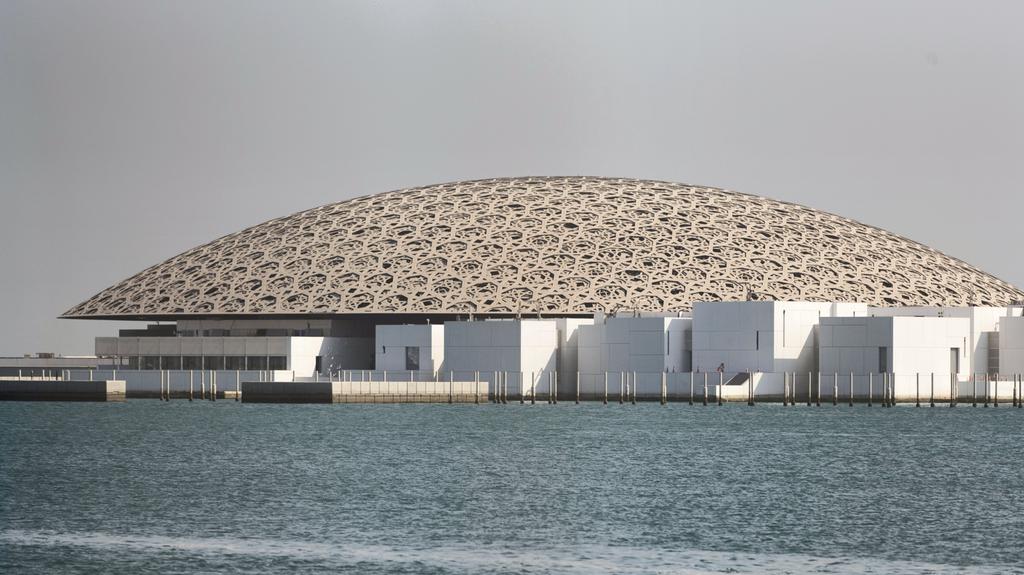 The Louvre Abu Dhabi The Louvre Abu Dhabi, designed by Jean Nouvel, opened in November after years of delay and a cost rumored to be in the hundreds of millions of dollars. The same weekend as LAD's grand opening, the NYU Abu Dhabi Arts Center hosted the world premiere of Parable of the Sower, an opera composed by the singer/songwriter Toshi Reagon, a queer Brooklyn-based activist, and based on the prophetic novel by Octavia Butler. At first glance, it seems unlikely that a "starchitect" museum in Abu Dhabi, where gas is cheap and water is expensive, would stage an opera about a fiery, drought-ridden apocalypse. And yet, taken together, the museum and the opera initiate a set of conversations—about art and culture and change—that upend stereotypes about the Gulf. The book Parable of the Sower (1993) was intended as the first of a trilogy. It's set in a world where California is burning, rivers have dried up, and the president sells entire towns to the highest corporate bidder. Violence is everywhere, and not even houses of worship are safe. In the second book, Parable of the Talents (1998), a president is elected who promises to "make America great again." The third book was never published. Given Butler's prescience about America's worst impulses, perhaps it's best that the third book never came out: Do any of us really want to know how bad things might become? The teenage heroine of the story, Lauren Olamina, flees her town on the outskirts of Los Angeles after the neighborhood is burned and looted by "pyros," people addicted to a drug that makes fires better than sex. Along with two other survivors from the neighborhood massacre, Lauren decides to walk north, perhaps to Canada or to anywhere where "water doesn't cost more than food." The subject matter of Parable doesn't immediately suggest "opera." But, as Reagon told me, "theater is a great way to talk about hard things." Working in collaboration with her mother, Bernice Johnson Reagon, founder of the musical ensemble Sweet Honey in the Rock, Toshi Reagon used the novel as the basis for a song cycle. The song cycle debuted in 2015, and the opera version two years later, although Toshi describes it still as a "work in progress." She wanted it to be seen. "After Trump was elected," she said, "the conversation [started by the novel] needed to happen now. We can't wait." Given that the devastation of climate change is one of the "hard things" addressed in the opera, staging this work in Abu Dhabi takes on a dramatic resonance: Abu Dhabi faces the very real possibility of running out of its water reserves within the next thirty-five years (and relies on desalination for more than 90 percent of its domestic water consumption). The West doesn't generally think of the Gulf as a place where conversations about climate change are taking place. Instead, the West seems to view the Gulf as a bling-bling country that stops counting its petrol dollars only long enough to oppress its migrant labor force. "The Middle East" is just a swirl of veiled ladies, oil rigs, and the occasional jihadi. But were these stereotypes the full picture, the repressive government of the Emirates would have long ago swooped in to shut down the opera Parable. They have not, and yet the opera follows in the long tradition of protest music (Toshi is named for the wife of her godfather, Pete Seeger), and issues a clarion call for social and political change. As Lauren walks north, she spreads a religious message. She calls her religion Earthseed, and one of its fundamental principles is that "all you touch you change. All that you change changes you. The only lasting truth is change. God is change." What begins as an escape from the wreckage of her town becomes a quest to start an Earthseed community. Her urgency to change the world propels her onward.  Toshi Reagon The opera stays true to the bleakness of the novel, with one significant alteration, which Reagon explains to the audience about midway through the performance. "Octavia Butler included all kinds of people in her novel, but she didn't call up a folk singer," she says, and shakes her head in disbelief. "You gotta have a folk singer, who will sing a very long song with lots of details, and a singable chorus—every movement needs a folk singer." And then, at every performance, she paused here and smiled. "So I put myself in it, and there's a part in here for you, too." The folk song, "Olivar Blues" is about a town that gets sold to a corporation called KSF. Lauren is surprised that the town allows itself to be sold, because it's "upper middle class, white, [and] literate." But the town is crumbling into the sea on the one side and under siege from the migrating poor on the other, and KSF promises to keep the town safe. In exchange, KSF gets a ready supply of cheap labor and access to the town's water. "Olivar Blues" lives up to Toshi's description: it's a long song about how gentrification, corporate greed, and the seductive ease of online life erode our communities, without our even noticing. The song tells us that we should have "given two fucks," we should have "done more to make some changes." The chorus—the audience part—is simple: "don't let your baby go to Ol-i-var." At every performance I attended, the audience sang, and loudly, right through to the song's final lines: "fight, fight, strat-e-gize, stay together, equal rights." As we sang, I looked around. A few rows in front of me, I saw a mild-mannered Emirati student of mine punching her fists in the air, while her friend, a girl from Korea, stamped her feet and swayed to the beat. When I talked with those students after the show, they said it was "amazing," and "awesome." They loved the singing. "It's like we were in it together," they said. What we were "in" was a moment of communal power, a space devoted to the possibility of change. The chaos in the world of Parable mirrors our own moment, in which it is impossible not to imagine that an apocalypse is imminent. And yet, because we get to sing along, the opera creates a sense of optimism lacking in the novel: It's hard to sing along with a book. The opera encourages—even demands—that we sing and clap, that we whoop and stamp our feet. As I sang along to "Olivar Blues," I thought about the migrant workers in Abu Dhabi living in labor camps outside of town—and then wondered about migrant workers living in similar conditions in the U.S. When the ensemble sang "it don't rain no more," I thought about the irrigation hoses that coil around every tree in Abu Dhabi, and those in turn reminded me of the images from California and Western Canada over the past few months, in flames from drought-fueled wildfires. The opera created a kind of double mirror, reflecting on the world in multiple directions. That reflection process also happens in the galleries of the Louvre Abu Dhabi, which create a conversation between East and West without the West being automatically situated as dominant. The thematic arrangement of the galleries means that you might see a Quran displayed next to a carved Madonna next to a statue of Shiva—and while you might disagree with this method, you can't help but think about the global circulation (and appropriation) of ideas, images, and artifacts. The museum and the opera remind us that change doesn't happen in a steady trajectory or a tidy timeline. Earthseed stipulates that "the only lasting truth is change," but as Lauren's journey makes clear, planting the seeds of change requires engagement and persistence. At the end of the opera, Toshi sings the Biblical version of the parable of the sower, which in the King James translation refers to the "good ground" that is needed for seeds to grow. Parable and the Louvre Abu Dhabi suggest that fertile ground can be found even in the desert. Deborah Lindsay Williams is the program head for Literature and Creative Writing at NYU Abu Dhabi, and a columnist for The National, the English language newspaper of the United Arab Emirates. Recent work of hers has appeared in the New York Times, Inside Higher Ed, and Vogue.com. She is writing a book about Abu Dhabi and New York. Powered by WPeMatico The post Staging Octavia Butler in Abu Dhabi appeared first on Guaripete. |


| You are subscribed to email updates from Books Trending News. To stop receiving these emails, you may unsubscribe now. | Email delivery powered by Google |
| Google, 1600 Amphitheatre Parkway, Mountain View, CA 94043, United States | |

No comments:
Post a Comment